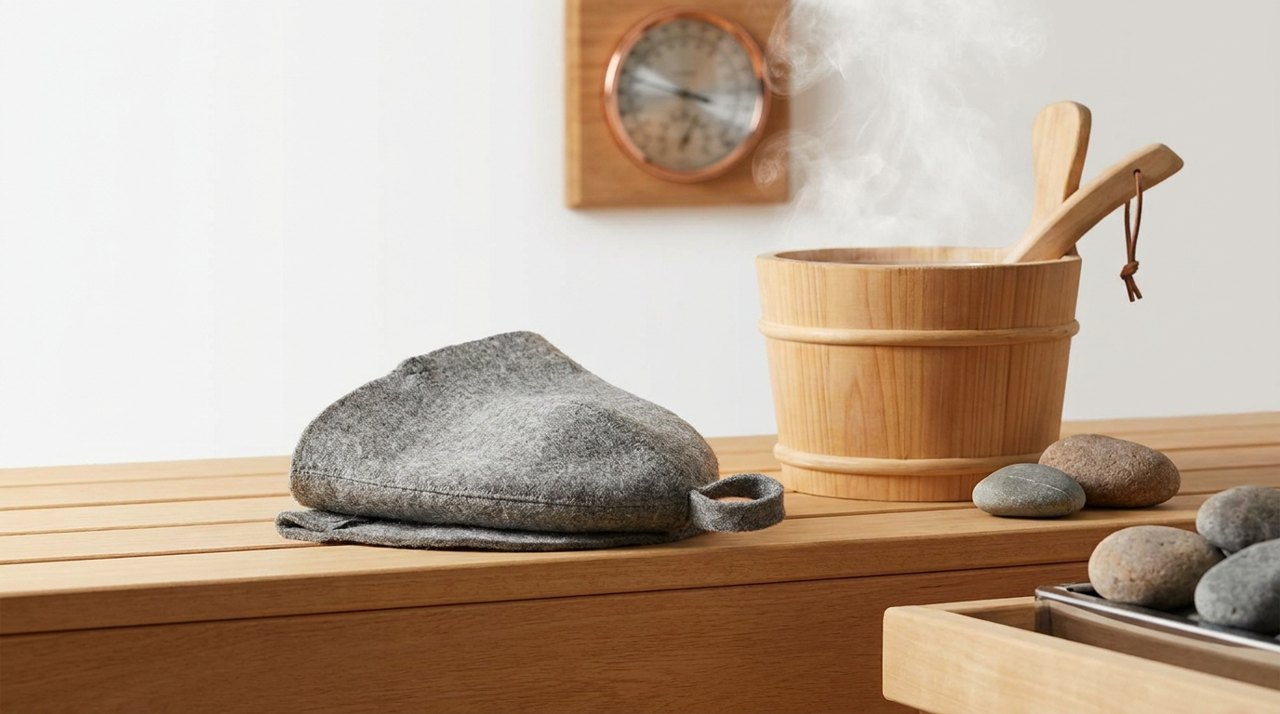
Ask ten people how hot a sauna is and you'll get ten different numbers — because they're all right, about different saunas. A Finnish dry sauna, a Russian banya, a steam room and an infrared cabin can span a range of more than 100°C between them. And even inside a single sauna, the temperature on the sign by the door isn't the temperature your body actually experiences. Where you sit — and more specifically, where your head sits — changes everything.
The headline numbers, by sauna type
Here's the honest overview, based on what you'll actually encounter rather than what brochures claim:
| Type | Typical air temperature | Humidity | How it actually feels |
|---|---|---|---|
| Finnish dry sauna | 80–100°C (176–212°F) | 10–20%, spiking with löyly | Intense but breathable dry heat; steam bursts hit hard |
| Russian banya | 60–90°C (140–194°F) | 40–70% | Lower on the thermometer, heavier on the body |
| Steam room (hammam) | 40–50°C (104–122°F) | ~100% | Mild temperature, zero evaporative cooling |
| Infrared cabin | 45–60°C (113–140°F) | Low | Gentle air, direct radiant heating of the skin |
The trap in this table is comparing raw temperatures. A 70°C banya at 60% humidity is subjectively more brutal than a 95°C Finnish sauna at 12% humidity, because humid air dumps heat into you faster and your sweat stops evaporating efficiently. Banya regulars know this; first-timers learn it in about ninety seconds. If the banya tradition interests you, we've written about why the felt banya hat became inseparable from that culture — it's not decoration, it's equipment.
The thermometer is lying to you (sort of)
Hot air rises. Everyone knows this, but few people appreciate how dramatic it is inside a small wooden box with a 90°C stove in the corner. Sauna air stratifies into distinct layers, and the gradient is steep:
- Floor level: often just 30–40°C. You could keep a houseplant alive down there.
- Lower bench: roughly 60–70°C in a sauna that reads 90°C at the sensor.
- Upper bench, seated: 80–95°C at chest height.
- Upper bench, head height: 95–110°C and beyond, especially right after water hits the stones.
That's a difference of 30–40°C — sometimes more — between your feet and your scalp in the same room, at the same moment. The wall thermometer is usually mounted somewhere in the upper-middle zone, which means it's reporting neither your coolest nor your hottest experience. In a proper Finnish sauna sitting tall on the top bench, your head is frequently in air hotter than the posted temperature, while your ankles are enjoying a mild spring day.
Why your head takes the worst of it
Your head is uniquely badly positioned for sauna heat, for three stacking reasons:
- Altitude. It's the highest part of your seated body, parked in the hottest air layer in the room.
- Steam exposure. When löyly rolls off the stones, that superheated humid air travels along the ceiling first. Your head meets it before the rest of you does — anyone who's been caught mid-conversation by a fresh ladle of water knows that scalp-prickling wave.
- Poor insulation. Your skull has thin skin, minimal fat and dense blood supply near the surface. Ears and scalp heat up fast, and hair — especially dry hair — is a surprisingly poor shield against radiant and convective heat. Dry hair can reach temperatures that damage the cuticle well before your core temperature has meaningfully risen.
The practical result: your head overheats before your body is done. That creeping dizziness or throbbing temples that cuts a session short at eight minutes usually isn't your core crying for mercy — it's your head, sitting 30 degrees hotter than your torso, tapping out early. This is the entire physical logic behind sauna hats, which we've broken down properly in Why Wear a Sauna Hat? The Benefits, Explained by Physics: insulate the head, slow its heating, and the rest of your body gets the full session it can actually handle.
When head protection matters most
Honestly, not every heat session demands a hat. Here's the real hierarchy:
- Banya — essential. High heat plus high humidity plus vigorous steam work (and often venik whisking, which stirs the hot ceiling layer downward) makes the banya the sauna hat's homeland for good reason. Nobody serious steams bareheaded.
- Finnish sauna, top bench, 90°C+ — strongly worth it. Especially if you like long sessions, generous löyly, or you're tall enough that your head lives near the ceiling. Also if you have color-treated or dry hair, or a shaved head with nothing between scalp and air.
- Finnish sauna, lower bench, moderate heat — optional. At 70°C on the middle bench, a hat is comfort rather than necessity.
- Steam room — different problem. At 45°C the air won't cook your scalp, though many people still cover their hair against the moisture.
- Infrared — rarely needed. The air is mild and there's no steam; stratification barely matters here.
The classic solution is thick felted wool, and it works precisely because of the physics above: wool traps a layer of still air around your head, and still air is a terrible conductor of heat. A well-made one like the this handmade wool felt hat keeps the space under the brim tens of degrees cooler than the ceiling air — you feel the löyly wave pass over you rather than through you. If you want to compare shapes, thicknesses and materials before committing, the classic and bucket styles covers the classic styles, and the same hat is available on Amazon if that's easier for you.
Practical takeaways
A few things worth carrying into your next session:
- Read the room's thermometer as a rough middle value, not what your head experiences. Add 10–20°C for the top bench at head height; subtract 20–30°C for the lowest bench.
- If a session feels too intense, move down one bench before you leave the room — you'll drop the effective temperature more than you'd expect, and your feet-to-head gradient shrinks too.
- In humid heat (banya, heavy löyly), trust how you feel over the number on the wall. Humidity is the multiplier the thermometer doesn't show.
- If your head consistently gives out before your body, insulate it. Longer, more comfortable sessions are the whole point — and if you're not sure what to look for in a hat, our guide to choosing a sauna hat by material, thickness and fit walks through it without the marketing fog.
So how hot is a sauna, really? Anywhere from 40°C to 110°C depending on the type, the bench, and the last ladle of water — and the most important number in the room is the one hovering right at your hairline.