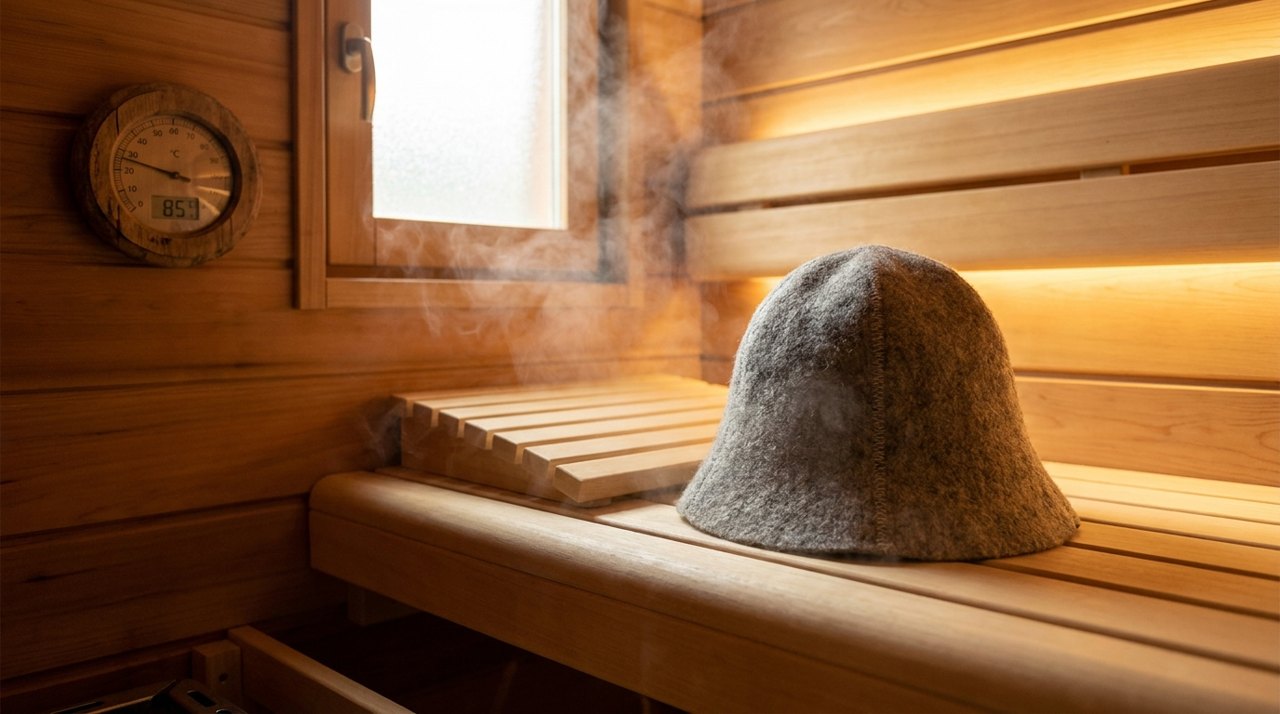
Walk into any Russian banya and you'll see people sitting in a room heated to 90 °C wearing thick felt hats. To the uninitiated it looks backwards — a winter hat in the hottest room you'll ever voluntarily sit in. But the hat isn't there to keep the head warm. It's there to keep the head cool, and the reason it works comes down to some fairly simple physics.
The hot room is not evenly hot
The first thing to understand is that a sauna is not one temperature. Hot air is less dense than cool air, so it rises and stratifies into layers. The thermometer on the wall of a Finnish sauna might read 80 °C, but that number describes one point in the room. Down at floor level it can be 40 °C; up at ceiling height, above the top bench, it can push past 100 °C. The gradient is steep — in a typical sauna the temperature can climb by roughly 10 °C or more for every step up the benches.
Now consider where your head is. If you're sitting upright on the top bench, your head occupies the hottest stratum of air in the entire room, while your feet may be sitting in air 30–40 °C cooler. Your body is being heated unevenly, and the part getting the most heat is the part you'd most like to protect: it's densely supplied with blood, it's where you sense overheating first, and it's covered in hair that dry heat treats badly.
When someone throws water on the stones (the löyly in Finnish tradition), it gets briefly worse. The steam pulse rides the convection current up to the ceiling and rolls across it — straight over your head — before dissipating. Anyone who has caught a fresh löyly wave on bare ears knows exactly what that feels like.
Why a wool hat cools you down (sort of)
A sauna hat doesn't lower your body temperature. What it does is slow the rate at which heat enters your head, which changes how the session feels and how long you can comfortably stay.
Heat reaches your head in the sauna three ways:
- Convection — hot air moving across your scalp and ears, the dominant mechanism, and the one that spikes when steam hits.
- Radiation — infrared energy from the stove, the stones, and the hot ceiling directly above you.
- Conduction — negligible for your head unless you lean it against the wall.
Wool felt is a genuinely good insulator against the first two. The material itself conducts heat poorly (thermal conductivity around 0.03–0.04 W/m·K, in the same league as fiberglass insulation), but the real work is done by the air trapped in the felt's fiber structure. Still air is one of the worst heat conductors there is, and a centimeter of felted wool holds a lot of it. The hat creates a buffer layer: the air against your scalp stays close to skin temperature while the outside of the hat sits at room temperature, and the felt sustains that gradient.
The same insulation works in both directions, which is the counterintuitive part. In winter the hat keeps body heat in; in the sauna it keeps ambient heat out. There's a bonus too: your scalp sweats, and the wool draws that sweat into the fibre and away from your skin — without the hat becoming clammy, because wool can absorb around a third of its weight in water before it feels wet. Just put it on dry: dry felt full of trapped air is what does the insulating.
What this actually gets you
Being honest about it: a sauna hat is a comfort device, not a health device, and nobody should claim otherwise. But the comfort gains are real and specific.
- Longer sessions at your own pace. For most people, the limiting sensation in a sauna is the head — throbbing temples, hot ears, that "cooked" feeling. Insulate the head and your perceived limit moves. You end the session when your body says so, not when your ears do.
- Higher tolerable temperatures. Banya regulars who like it properly hot treat the hat as non-negotiable. The steam pulse that would drive a bareheaded visitor off the top bench becomes merely intense.
- Hair protection. Hair is dead keratin with no way to repair itself. Dry air at 80–100 °C strips moisture from the hair shaft, and repeated exposure leaves hair brittle and dull. Color-treated hair fares worse. A hat keeps the hair at a far milder temperature and humidity.
- Scalp and ear comfort. Ears have thin skin, little fat, and lots of surface area — they heat up fast and complain loudly. A hat with decent coverage simply takes them out of the equation.
Why felt, specifically
Tradition settled on felted wool centuries ago, and the physics backs the tradition up. Felt is thick enough to trap meaningful air, holds its shape without contacting the scalp everywhere (that air gap is extra insulation), breathes, and shrugs off sweat. Synthetics are a poor substitute: many soften or off-gas at sauna temperatures, and they don't manage moisture the way wool does. Cotton absorbs sweat, stays soggy, and a wet hat conducts heat far better than a dry one — the opposite of what you want.
Thickness matters more than most buyers expect. A thin decorative hat insulates noticeably less than a dense 3–4 mm felt. A classic example of the traditional design done properly is the a thick felt hat like this one — dense felt, deep enough to cover the ears, no synthetic lining to defeat the purpose. It's also available on Amazon if that's easier. If you're comparing options more broadly, we've covered materials, thickness, and fit in detail in How to Choose a Sauna Hat.
A tradition older than the thermometer
None of this is a modern discovery. In the Russian banya, the felt hat (shapka) has been standard equipment for generations, alongside the felt mitt and the bundle of birch twigs. Banya culture runs hotter and steamier than most Finnish saunas, and the hat is what makes long sessions on the top shelf possible. In Finland, hat use is more variable — plenty of Finns go bareheaded in gentler home saunas — but felt hats are a familiar sight in hotter public saunas and at competitive löyly events, and Finnish felt-makers produce some beautiful ones.
The people who built these traditions had no infrared cameras or stratification charts. They just noticed, over a few hundred years of practice, that a felt hat let you sit longer, take harder steam, and walk out feeling better. The physics merely explains what the practice already knew.
The short version
| Without a hat | With a wool hat |
|---|---|
| Head sits in the hottest air layer, heating faster than the body | Felt buffers convection and radiation; head heats at a pace closer to the body's |
| Session often ends when ears and temples give out | Session ends when the whole body has had enough |
| Dry heat dries and stresses hair | Hair stays at milder temperature and humidity |
| Steam pulses hit bare skin at full intensity | Löyly waves are felt, not endured |
A sauna hat costs about as much as a decent towel and lasts for years. If you take your sauna time seriously — or want to — it's the cheapest meaningful upgrade there is. When you're ready to pick one, browse the the DIVELUX collection or start with our honest buyer's guide to the best sauna hats in 2026.