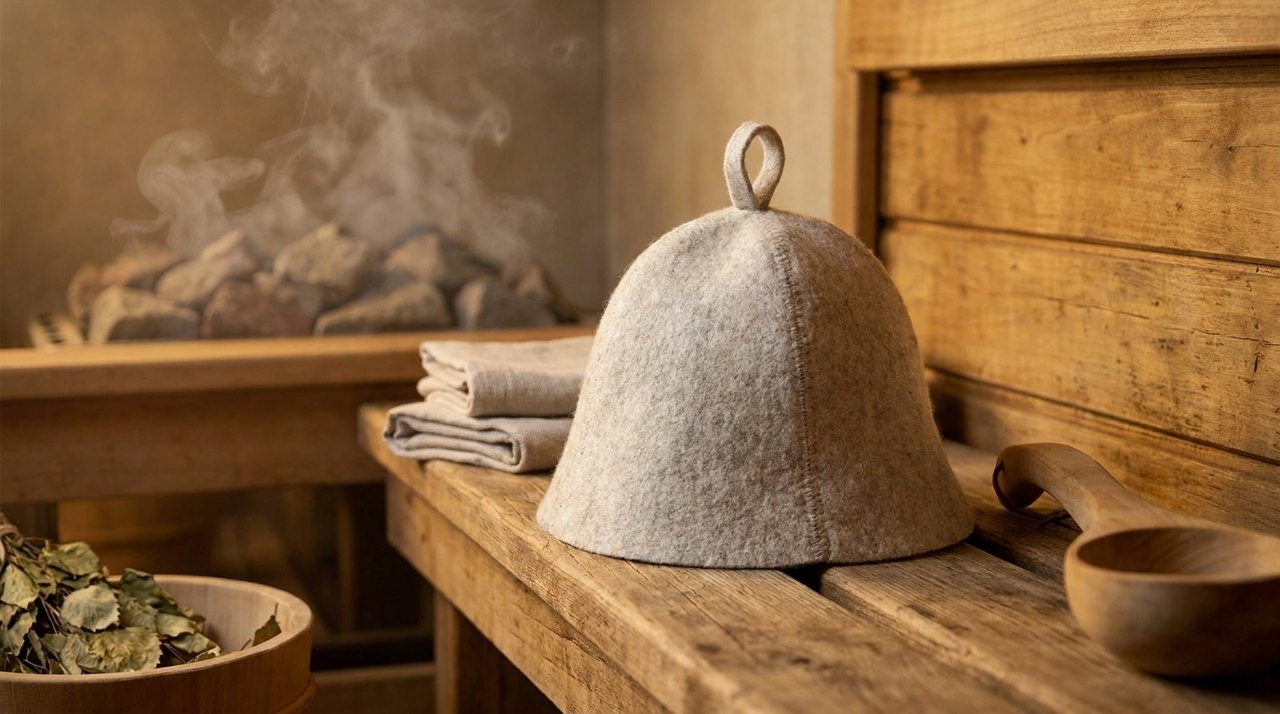
Walk into a Russian banya without a hat and someone will hand you one. Walk into a Finnish sauna wearing one and nobody blinks. Wear one at an American gym and you'll spend half your session answering questions. Same piece of felted wool, three completely different social contexts — and knowing the difference is most of what sauna hat etiquette actually is. Here's how to wear one gracefully wherever you steam, plus the hygiene and handling habits that mark you as someone who knows what they're doing.
Russian banya: the hat is expected
In a Russian banya, the hat isn't an accessory — it's part of the uniform, alongside the felt mitt and the venik (the leafy birch or oak whisk). Banya runs hotter and wetter than most Finnish saunas, often 70–90°C with steam thrown aggressively onto the stones, and the traditional wisdom is blunt: protect your head or cut your session short. The felt cap insulates your scalp and ears from the sharpest heat, letting you stay in for the full venik treatment. We cover the full history in The Russian Banya Hat: History, Meaning and Why It Survived, but the practical takeaway is simple.
Etiquette points that matter in a banya:
- Bring your own or accept a loaner graciously. Established banyas usually sell or lend hats at the front desk. Regulars bring their own — showing up with a proper felted wool cap signals you've done this before.
- Keep it on in the parilka (steam room), take it off outside. The hat belongs in the hot room. Wearing it into the plunge pool or the tea room looks odd; hang it or carry it.
- Don't mock the novelty hats. Caps shaped like Soviet army helmets or printed with jokes ("Banya General" is a classic) are part of the culture. Humor is traditional; snobbery isn't.
- Never borrow a stranger's hat. It's a personal item, like a towel. Ask the attendant for a house hat instead.
Finnish sauna: common, optional, unremarkable
Finland is more relaxed about it. Plenty of Finns sauna bareheaded their whole lives; plenty of others — especially competitive-sauna types, ice swimmers, and anyone who sits on the top bench through repeated löyly — wear a felt cap without a second thought. Nobody will comment either way. If you're in a public sauna in Helsinki wearing a grey wool cap, you're just another bather.
Two local customs worth knowing. First, the sit-towel rule is far more important than any hat rule: always sit on a towel or pefletti (disposable bench liner). Get that wrong and the hat won't save your reputation. Second, if the sauna has a shared hat rack by the door, that's for hats between rounds, not communal use — same as the banya, hats are personal.
One genuinely useful courtesy: if you're wearing a hat and staying on the top bench for a long stretch while others rotate out, be mindful of the löyly. The hat lets you tolerate more steam than the bareheaded person next to you. Throw water for the room, not for your own insulated comfort level.
US gyms and spas: rare, but the curve is bending
In American gym saunas, a sauna hat still turns heads. Ten years ago you'd have been the only one in the state; now, between banya culture spreading through cities like New York and Chicago, the cold-plunge boom, and sauna content all over social media, hats are showing up in ordinary health clubs. They're still uncommon enough that you should expect attention.
A few situational notes:
- Check the posted rules first. A handful of gyms have blanket "no headwear in the sauna" policies written with baseball caps in mind. A quiet word with the front desk ("it's a wool sauna hat, it insulates against heat, it's standard in European saunas") almost always resolves it.
- Infrared saunas are a different case. They run at 45–60°C, cool enough that a hat is genuinely unnecessary. Wear one if you like, but the thermal argument mostly disappears — the physics is laid out in our benefits explainer.
- Upscale spas are the easiest venue. Bathhouse-style spas increasingly sell hats in their own shops. If the spa has an aufguss ritual on the schedule, a hat is close to standard equipment for sitting through the full towel-waving heat wave.
How to answer the inevitable questions
You will be asked. Usually it's genuine curiosity, occasionally light teasing, and the best response to both is the same: short, friendly, factual. Something like: "It insulates my head so the rest of me can stay in the heat longer — it's standard in Russian and Finnish saunas." That's it. Most people's follow-up is "wait, it keeps you cooler?" and the one-line answer is that wool is an insulator, so it slows heat reaching your head the same way it slows heat leaving it in winter.
What not to do: deliver a lecture, or get defensive. A hat worn matter-of-factly normalizes itself within a few visits. Regulars at my gym went from jokes to questions to two of them buying their own hats inside three months. If someone asks where to get one, pointing them to a basic felted wool cap — the a 100% wool hat such as DIVELUX in grey is the kind of unflashy classic that works in any of the three settings above — answers the question without turning the bench into a sales floor. It's also on Amazon for people who'd rather not remember a URL.
Hygiene etiquette: the part that actually matters
The unwritten rules across every sauna culture reduce to one principle: your hat touches only you. Beyond that, keeping it clean is what separates a well-kept tool from a sour-smelling one.
| Habit | How often | Why |
|---|---|---|
| Air-dry fully after each session | Every visit | A damp hat stuffed in a gym bag breeds mildew within days |
| Rinse in cool water, no soap | Every few sessions | Removes sweat salts without stripping the wool's lanolin |
| Gentle hand-wash with wool detergent | Every 1–2 months | Deep-cleans without felting the cap smaller |
| Never machine-wash or tumble-dry | — | Heat plus agitation shrinks felted wool dramatically |
Reshape the hat over a bowl or your knee while it's damp and let it dry away from radiators. Wool is naturally odor-resistant, so a well-aired hat stays fresh far longer than you'd expect — but "naturally resistant" is not "immune."
Storing your hat between rounds
A proper sauna session is several rounds with cooldowns between, and what you do with the hat in the gaps is a small but real courtesy. In the hot room's doorway there's often a row of hooks — use them. Don't leave your hat on the bench holding your spot (bench space is shared), don't set it on the stove guard (obviously), and don't wear it into the shower or plunge, where it'll soak through and take an hour to recover its insulating loft. Between rounds a hat should hang somewhere ventilated; a soaked hat insulates noticeably worse because water conducts heat far better than trapped air.
At home or traveling, store it dry and uncrushed. Felted wool holds its shape well, but months squashed flat under gear will leave a crease. If you sauna somewhere with communal hooks, a distinctive hat also saves the awkward two-people-one-grey-hat moment — one argument for the more characterful shapes in the the store, or at minimum for initialing the inside brim.
The short version
- In a banya, wear one; it's expected and appreciated.
- In a Finnish sauna, wear one if you like; nobody cares, but respect the sit-towel rule above all.
- In a US gym or spa, check posted rules, keep your explanation to one friendly sentence, and let the hat normalize itself.
- Your hat is personal: never share, never borrow, always dry.
- Between rounds, hang it — never on the bench, never in the shower.
Etiquette, in the end, is just competence made visible. If you're still choosing your first hat, our guide to material, thickness, fit and style covers what to look for before you ever have to explain it to anyone.