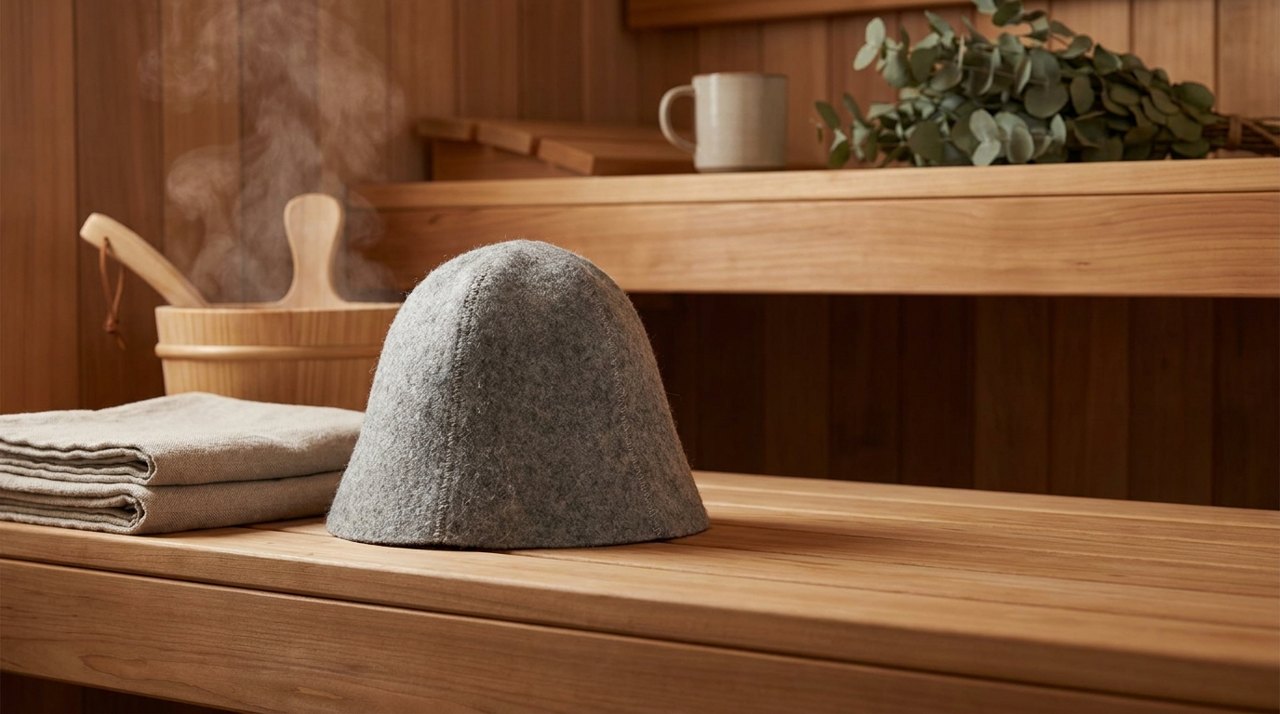
Type "sauna hat" into Amazon and the first page is a wall of $8 to $12 multipacks: two, three, sometimes five hats for the price of a lunch. They look the part in the photos. Some of them are fine. Most of them are not what the listing implies, and the difference shows up in exactly the place a sauna hat is supposed to work: on your head at 90°C. Here is what that money actually buys, when it is enough, and when it isn't.
What a $10 sauna hat is usually made of
The tell is in the material line, if you can find it. Budget multipacks are almost always one of three things:
- Polyester or acrylic "felt." Needle-punched synthetic fiber pressed into a sheet. It photographs like wool, weighs about half as much, and has none of wool's moisture behavior.
- Wool blend. Typically 20 to 40 percent wool with the rest synthetic. The listing will say "wool felt" in the title and put the real ratio, if anywhere, in a bullet halfway down the page.
- Thin true wool. Occasionally a cheap hat really is wool, but at 2 to 3 mm thickness, cut and glued rather than shaped. This is the best of the budget options and still noticeably worse than a proper felted hat.
Why does the material matter so much? Because a sauna hat is not a fashion item, it is a piece of insulation. Its whole job is to keep a layer of dry, trapped air around your scalp so it stays cooler than the air near the ceiling, while soaking up sweat so it never sits against your skin. Thick wool felt does both. Thin polyester does neither well, for reasons we go into in Do Sauna Hats Actually Work?.
When a cheap hat is genuinely acceptable
I am not going to tell you that a $10 hat is useless. There are real situations where it is the right purchase:
- Guests. If you run a home sauna and want a basket of hats for visitors, a multipack is practical. Guests wear a hat for one session, it gets washed, and nobody minds that it is a bit thin.
- Trying the idea. If you have never worn a sauna hat and want to know whether you like the feeling before spending more, $10 is a cheap experiment. Just know you are testing a weak version of the concept.
- Infrared and mild saunas. At 50 to 60°C the insulation demands are low. Almost any hat keeps your head comfortable, and the shortcomings of thin synthetic barely register.
- Kids. Children outgrow things and lose things. A cheap hat that fits now is a sensible call.
Where they fail, and why
Take a budget hat into a real Finnish sauna or a banya at 90 to 100°C and the problems arrive in a predictable order.
- It heats through. Thin felt has little mass and little trapped air. Within ten minutes the inside of the hat is close to the temperature of the outside, and your scalp is warm under it. The hat is now a warm cap, not a shield. A thick wool hat still feels cool inside at the same point.
- Synthetic felt gets hot to the touch. Polyester conducts and holds heat differently from wool, and at high temperature the top of a synthetic hat can be uncomfortably hot when you touch it. Some users report a faint plastic smell as well.
- It does not handle sweat. Wool pulls sweat into the fibre and still feels dry against your forehead; polyester leaves it sitting on the surface, so a cheap hat turns clammy halfway through a round. Either way, the hat is meant to be worn dry: dry felt full of trapped air is what insulates your head. Should You Wet Your Sauna Hat? No — Wear It Dry explains why.
- Smell. Wool is naturally antimicrobial and airs out overnight. Synthetic fiber holds sweat and bacteria, and after a few weeks of regular use many cheap hats develop a sour smell that a rinse does not fix.
- Shrinkage and distortion. Cheap wool-blend hats often shrink unevenly in the first wash because the two fibers behave differently. Glued seams let go. The brim curls. A hat that fit at purchase is snug and lopsided a month later.
- Fit. Multipacks come in one size, cut from flat sheet and stitched. They sit high, slide off when you lean back, and have no room for long hair.
How to read a listing for red flags
Amazon listings for sauna hats are written to survive a two-second glance, so you have to read against the grain. Look for these:
- "Wool felt" in the title but no percentage anywhere. Genuine 100 percent wool is a selling point and sellers who have it say so. Silence usually means a blend or synthetic.
- Weight listed under 100 grams per hat. A real felted wool hat weighs 150 to 250 grams. If the shipping weight for a three-pack is 250 grams, do the math.
- Thickness not mentioned. Good makers quote it because it is the number that matters. Look for 4 mm or more. Anything at 2 to 3 mm is a cap.
- "Felt-like," "wool-feel," or "eco-felt." These are polite names for polyester.
- Studio photos only. If every image is a hat on a white background and there is not a single shot of it on a head in a real sauna, the seller may never have tested it.
- Reviews that mention smell, shrinking, or "thinner than expected." Filter to three-star reviews. Those are the honest ones.
- Origin. Hats made in Russia, Finland, Estonia or Latvia come from places with a felting tradition. That is not a guarantee, but it is a good sign.
Cheap multipack vs a real wool hat
| $8-12 multipack | $20-30 100% wool felt | |
|---|---|---|
| Material | Polyester, acrylic or wool blend | 100% sheep's wool, felted |
| Thickness | 2-3 mm | 4-6 mm |
| Weight | 60-100 g | 150-250 g |
| Feels cool inside at 90°C | 5-10 minutes | Whole session |
| Holds water for cooling | Poorly | Well |
| Odor after regular use | Common | Rare |
| Shape after washing | Often shrinks or warps | Holds shape |
| Realistic lifespan | One season | Years |
When spending $20 pays off
The math is simple once you use a sauna more than a couple of times a month. A multipack gives you three hats that each last a season, so you are buying again next year. A proper 100 percent wool felt hat at $20 to $30 lasts several years of regular use and works better every single session in between.
The DIVELUX's $19.99 classic is a good example of what the extra money buys: dense felted wool that stays cool inside through a full hot session, a shaped crown that does not slide off when you lie down, and no synthetic smell after a summer of use. It is also available on Amazon if you prefer to keep everything in one cart, and the wider diveluxsaunahat.com includes larger sizes and colors if grey is not your thing.
It is worth saying plainly: the difference is not subtle. Anyone who has worn a thin synthetic hat and then a real felted one in the same session notices within minutes. The cheap hat is warm on top. The wool hat is not.
The honest verdict
A $10 Amazon sauna hat is fine for guests, for kids, for infrared cabins, and for finding out whether you like wearing one at all. For anyone who saunas regularly at real temperatures, it is a false economy. You will replace it, it will smell, and it will never do the one job it exists for as well as thick wool does. Spend the twenty dollars once. If you want to see how the budget options stack up against the field, our full buyer's guide ranks them side by side.
For a side-by-side table of the hats that actually sell on Amazon, from 2-packs to merino and linen, see Best Sauna Hats on Amazon (2026).