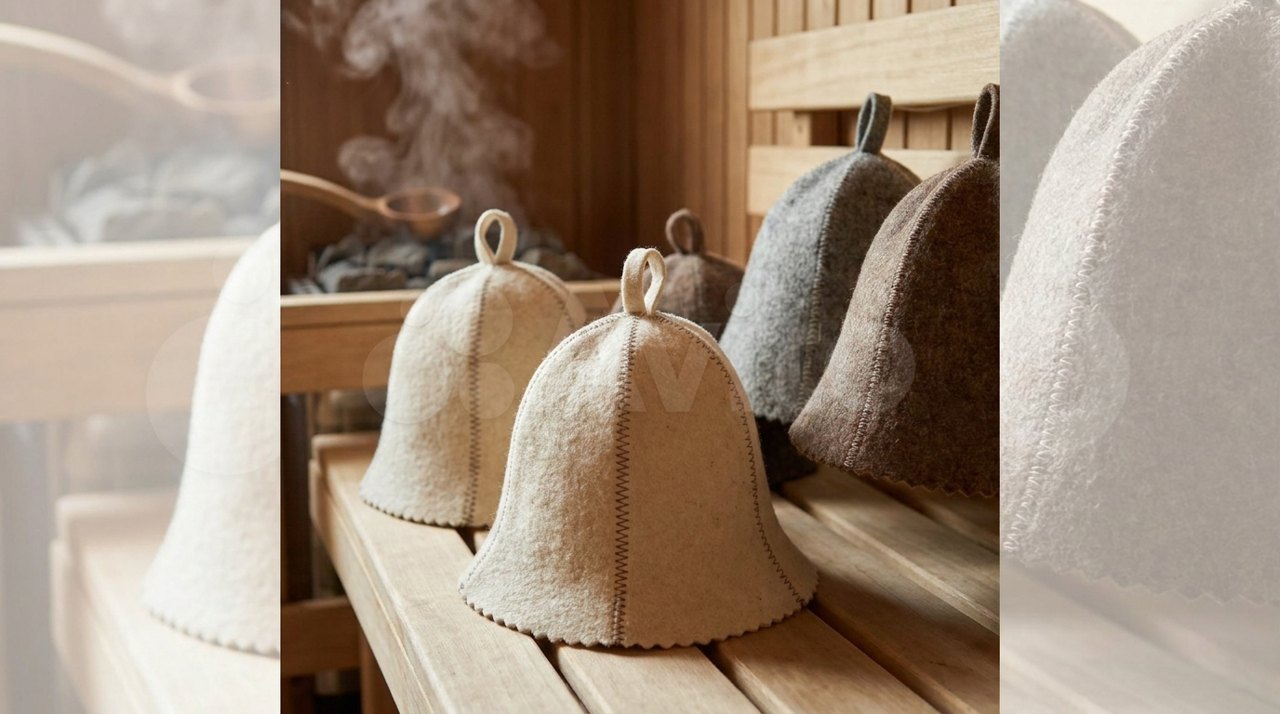
Ask ten sauna hat sellers what their hat is made of and nine will say "wool." Ask them to prove it and the number drops fast. Material is the single biggest factor in whether a sauna hat actually keeps your head cool, and the four common options are not close to each other in performance. Here is how wool felt, linen, cotton and synthetic felt rank, why the physics works out the way it does, and how to tell which one you are actually holding.
| Rank | Material | Insulation | Pros | Cons | Best for |
|---|---|---|---|---|---|
| 1 | 100% wool felt | Excellent | Traps still air, breathes, wicks moisture, naturally odor-resistant, holds shape | Costs more, needs hand washing, real wool is rarer than labels suggest | Finnish sauna, Russian banya, any dry heat above 80°C |
| 2 | Linen | Low | Light, dries fast, cool against skin, packs flat | Thin, little thermal protection, wrinkles, offers almost nothing in a hot dry sauna | Hammam, steam rooms, infrared cabins |
| 3 | Cotton | Poor | Cheap, soft, machine washable, absorbs sweat | Holds water, gets heavy, conducts heat once damp, slow to dry, sours quickly | Mild steam rooms, kids, backup hat |
| 4 | Synthetic felt (polyester, acrylic) | Poor, and gets worse | Very cheap, looks like wool on a photo, holds dye well | Does not breathe, traps sweat as a wet film, overheats, can smell of plastic, shrinks or melts at high temperatures | Honestly, nothing beyond a costume party |
A sauna hat works by slowing heat transfer from the air to your scalp, and the best insulator you can carry on your head is still air. Wool felt is roughly 80 percent trapped air by volume, held in place by crimped fibers that do not collapse when damp, so the insulating layer survives sweat. Materials that either have no air pockets (thin linen) or fill their air pockets with water (cotton) or seal off airflow entirely (synthetic) lose that advantage, which is why the ranking above falls out the way it does. If you want the longer version, the benefits of a sauna hat explained by physics goes through it properly.
Wool felt has been the banya and sauna hat material for centuries because it does several jobs at once. The fiber structure traps air, which is the insulation. The scales on each fiber wick moisture away from the skin and release it slowly, so sweat evaporates instead of pooling. Wool can absorb around a third of its weight in water before it feels wet, and even then it keeps most of its loft. Add natural lanolin, which resists odor, and you have a hat that can go through a season of weekly sessions without becoming unpleasant.
The differences within wool are thickness and density. A dense 5 to 6 mm felt is noticeably better in a 100°C Finnish sauna than a floppy 3 mm one, and it holds its shape rather than sagging onto your ears. The DIVELUX wool sauna hat is a good reference point for what proper felt feels like: stiff enough to stand on its own, but soft against the forehead, and it stays dry-feeling long after a cotton hat would be dripping. It is also sold on Amazon if you prefer that checkout.
Downsides are real but minor. Wool hats cost more, usually in the $25 to $60 range. They need hand washing in cool water and air drying, never a dryer. And you have to pay attention when buying, which brings us to the last section.
Linen gets a lot of praise in sauna hat listings, and the praise is accurate for a specific setting. Linen is light, dries quickly, feels cool against skin and does not hold odor. In a Turkish hammam or a steam room at 40 to 50°C with near 100 percent humidity, that is exactly what you want. A wool hat in a hammam just becomes a sponge of warm water pressed to your head.
The problem is that linen provides very little thermal insulation. It is a thin, flat weave with almost no trapped air. In a Finnish sauna at 90°C it will keep the direct radiant heat from the stove off your hair and shade your scalp, which is not nothing, but it does not slow heat transfer in any meaningful way. Think of it as sun protection rather than heat protection. If you split your time between dry sauna and steam, you genuinely need two hats.
Cotton sauna hats exist mostly because cotton is cheap and everyone knows how to sew it. The first few minutes feel fine. Then it starts absorbing sweat, and cotton absorbs a lot, up to 25 times its weight. Unlike wool, wet cotton loses its structure completely. The fibers collapse, the air pockets fill with water, and water conducts heat about 25 times better than air. What began as a mild insulator turns into a warm, wet compress on your head, which is the opposite of the goal.
Cotton also dries slowly and sours fast, so a hat that is used twice a week and hung in a damp changing room will smell within a month. If you have a cotton hat, it is still better than a bare head for the first stretch of a session, and it is fine for mild steam rooms. It just should not be your main hat for real heat. Sauna hat vs bare head covers what actually changes through a session, and a cotton hat sits somewhere in between.
Synthetic felt is polyester or acrylic fiber needle-punched into a sheet, and from a product photo it is indistinguishable from wool. Physically it fails on every count that matters. Synthetic fibers do not absorb moisture at all, so sweat sits on the inside surface as a film. The material does not breathe, so that film cannot evaporate. The result is a sealed, humid pocket that heats up faster than your bare head would, and people who try one often conclude that sauna hats do not work. That conclusion is fair for the hat they bought.
There is a second issue. Polyester starts softening around 240°C, well above sauna temperatures, but acrylic and low-grade blends can deform, stiffen or give off a faint plastic smell at the 100°C or more you will find near the ceiling of a hot sauna. Not dangerous, but not pleasant either.
This is the part sellers do not advertise. A large share of sauna hats sold for under $15, particularly the multipack listings, are synthetic felt described as "wool felt," "felt wool" or simply "felt." Genuine wool felt costs several times more per square meter than polyester felt, and a $9 hat with a $4 shipping cost cannot contain much of it. A few checks help:
None of this means every affordable hat is a lie, but the price floor for real wool felt is around $20, and anything far below it deserves scrutiny. If you are weighing a bargain listing, what $10 actually buys goes through the multipacks in detail.
For a Finnish sauna, Russian banya or any dry heat over 80°C, buy 100% wool felt and nothing else. For hammams and steam rooms, buy linen and expect it to protect against radiant heat only. Skip cotton unless it is the only option in the changing room shop, and skip synthetic entirely. If you want a single hat that covers the widest range of rooms, a mid-thickness wool felt is the answer, and the DIVELUX sauna hats collection has a few weights to choose between depending on how hot you like it. Fit, thickness and style are a separate question from material, and how to choose a sauna hat picks those up where this article leaves off.
Handmade from 100% natural wool felt. 7 colors, classic and bucket styles, one size fits most. $19.99 with free US shipping and 30-day returns.
Shop DIVELUX sauna hats →