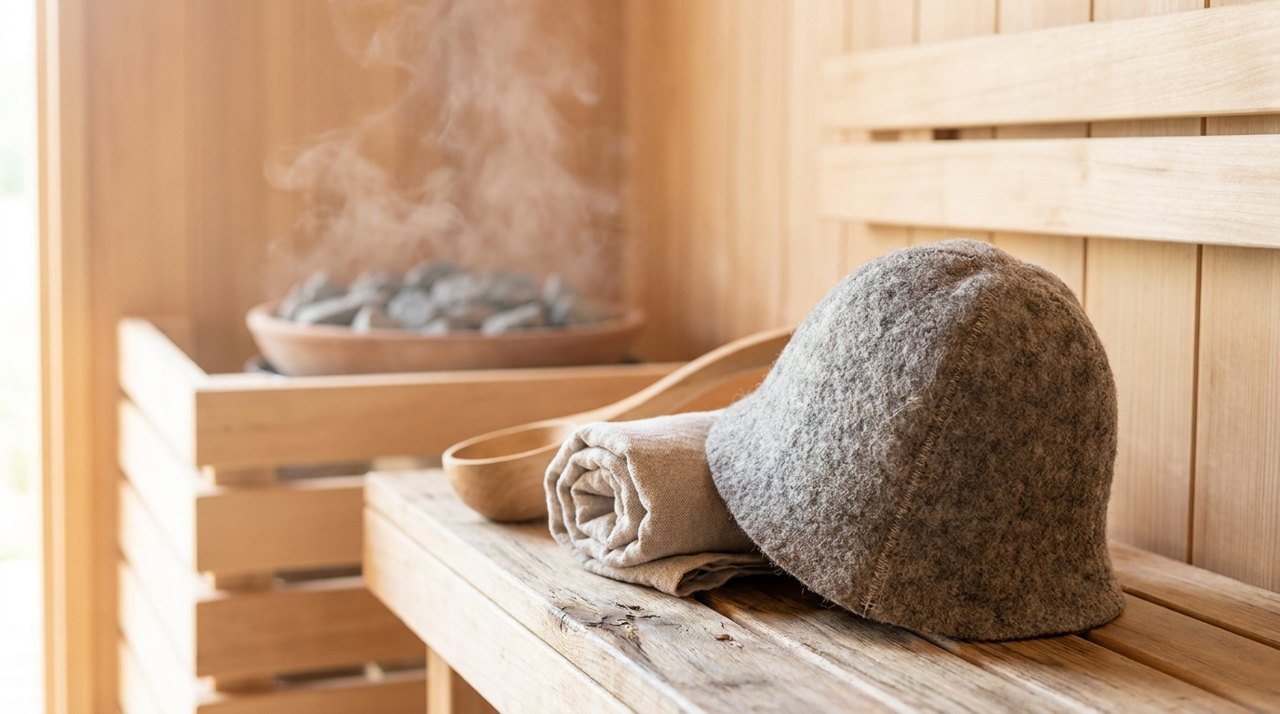
I spent two weeks alternating identical sauna sessions — same sauna, same 90°C, same three rounds — wearing a wool hat one day and going bare-headed the next. The differences weren't subtle, but they also weren't the ones the marketing copy promises. Here's what actually changes when you put a felted hat between your scalp and the hottest air in the room, and what stays exactly the same.
Why your head is the weak point in the first place
Heat in a sauna stratifies aggressively. The air at foot level on the lower bench might be 60°C while the air around your head on the top bench pushes past 90°C — the ceiling zone is always the hottest place in the room. (If you want the full breakdown by sauna type, see how hot a sauna really gets and where your head sits.) Your head is also poorly equipped for this. The scalp has thin skin, dense blood flow close to the surface, and — unless you're gifted with very thick hair — little insulation. Ears and the top of the head heat up faster than almost anywhere else on your body.
The result is a mismatch: your torso is still comfortably warming up while your head is already sending distress signals. Most people don't leave the sauna because their body has had enough. They leave because their head has.
The comparison, round by round
Subjective heat load
Bare-headed, the sensation on the top bench is unmistakable: a prickling, almost burning feeling on the crown and the tops of the ears within the first three or four minutes. It's not damage — it's just your most exposed skin reporting the hottest air in the room. With a thick felted wool hat on, that sensation simply doesn't arrive. Wool felt traps a layer of still air, and still air is a genuinely poor conductor of heat. The rest of your body sweats and heats up exactly as before; your head just stops being the loudest complainer.
The surprising part is how much this changes the character of the heat. Bare-headed, a hard session feels sharp and slightly hostile. With the hat, the same temperature reads as deep and enveloping. Nothing about the sauna changed. Only the reporting did.
Dizziness and early exits
Over my two weeks, the pattern was consistent: on bare-headed days I cut two of my third rounds short with that light-headed, "time to go" feeling. On hat days, zero. I won't dress this up as science — it's one person, and light-headedness in a sauna has many causes (hydration, blood pressure, how much you ate). But an overheated head is a plausible contributor, and removing the sharpest heat input at head level clearly made the sessions feel more controlled. I stopped bailing early because I stopped getting the warning signs that trigger bailing.
Hair and ears
This one is less about the session and more about the aftermath. Dry sauna heat is brutal on hair — it drives moisture out of the hair shaft, and if you go often, hair gets brittle and dull. Two weeks isn't long enough to measure that properly, but the immediate difference is obvious: bare-headed, my hair came out hot to the touch and straw-dry; under the hat it stayed cool and normal. If you have color-treated or long hair, this alone is a reason to wear one. Ears are the sleeper benefit — bare ear rims genuinely sting during a strong löyly, and the hat ends that completely.
Top-bench time and the full löyly
Here's the practical payoff. When someone throws a generous ladle of water on the stones, the steam pulse hits the ceiling first and rolls down — straight onto the heads of everyone on the top bench. Bare-headed, my instinct during a strong löyly was to duck, hunch, or retreat a bench lower. With the hat, I just sat there and took it, which is the entire point of the ritual. My top-bench time roughly doubled on hat days, not because I got tougher, but because the limiting factor was removed. This is exactly why the hat has survived centuries of banya culture — the Russian banya hat has a long history for precisely this reason, not as a costume.
The honest scorecard
| What changes | Bare head | With a wool hat |
|---|---|---|
| Scalp/ear heat sensation | Prickling, burning by minute 3–4 on the top bench | Essentially eliminated |
| Early exits from dizziness | Occasional, especially in round three | Rare — sessions end on your terms |
| Hair condition after session | Hot, dry, brittle-feeling | Cool and unchanged |
| Comfortable top-bench time | Shorter; steam pulses force you to duck or move down | Roughly doubled; you sit through the full löyly |
| How much you sweat | No meaningful difference — your body heats up the same either way | |
| Health outcomes | No claims here. This is a comfort tool, not a medical device | |
What a hat does not do
Let's be clear about the limits, because sauna accessories attract a lot of overselling. A hat does not make the sauna "healthier." It doesn't detox anything, it doesn't let you safely ignore real overheating, and if you feel genuinely unwell, wool on your head is not the fix — the exit is. It also doesn't reduce your sweat or your cardiovascular load; your body below the neck experiences the same session either way. What it changes is comfort and control: you decide when the round ends, rather than your scalp deciding for you. For the physics of why an insulating hat works in a hot room (yes, it sounds backwards), we've written up the benefits explained by physics.
If you want to run the experiment yourself
Any thick felted wool hat will demonstrate the effect — this is old, simple technology, and the material matters far more than the brand. I did my comparison in a DIVELUX's classic wool hat, which is a classic dense-felt design with good ear coverage; it's also available on Amazon if that's easier, and the broader their sauna hat lineup covers other shapes and colors. Whatever you buy, insist on real wool felt of decent thickness — thin synthetic novelty hats miss the point entirely.
Run it honestly: same sauna, same bench, same number of rounds, alternating days. Pay attention to minute counts, not vibes. My prediction, based on both the physics and my own notes: your sessions won't be hotter or healthier — they'll be longer, calmer, and yours to end. That's the whole trade, and for anyone who loves the top bench, it's a good one.