The sauna after training is one of those rituals that sits in a strange place: half the internet calls it a recovery superpower, the other half calls it placebo with a towel. The truth is narrower and more useful than either. Heat after a workout does some measurable things, does not do others, and — critically — is very easy to get wrong when you're already dehydrated, already fatigued, and already a bit lightheaded from a heavy set. Here's how to build a post-workout sauna habit that you can actually repeat three times a week without wrecking your sleep or your next session.
First: separate the goals
"Recovery" is a vague word. Break it into what you're actually chasing, because the answers differ:
- Feeling better right now — less muscle stiffness, a general downshift out of a stressed state. Sauna is genuinely good at this. It's the most reliable benefit, and it's mostly subjective, which doesn't make it worthless.
- Faster performance recovery — being able to hit the same numbers 24 hours later. The evidence is mixed and effect sizes are small. Some studies show modest improvements in perceived recovery and next-day readiness; others find no meaningful difference against passive rest.
- Adaptation — heat acclimation, plasma volume expansion, better thermoregulation in hot conditions. This one is well supported, but it requires consistent exposure over weeks, not one heroic session.
- Hypertrophy or strength gains from heat — the mechanistic story (heat shock proteins, mTOR signaling) is real in cell and animal models. The human evidence that a post-lift sauna adds muscle is thin. Treat it as a maybe, not a reason.
If you go in expecting the first and third, you'll be happy. If you go in expecting the sauna to erase a bad training block, you'll be disappointed and probably overdo it.
How long to wait after training
Give yourself 10–20 minutes between the last set and the first bench. You want your heart rate down near conversational levels and sweating to have slowed from its post-exercise peak. Going straight from a hard interval session into 90 °C is stacking two cardiovascular loads on top of each other — your heart rate will climb faster and higher than it would from a rested start, and your tolerance for the heat will be noticeably lower.
One exception worth respecting: if the session was long, hot, or outdoors, and you're already down significant fluid, skip the sauna that day. Heat on top of existing dehydration is where the genuinely bad outcomes live.
Hydration, specifically
Vague advice to "stay hydrated" doesn't help much when you're standing in the locker room. Some numbers to work with:
- A typical sauna session produces roughly 0.5 L of sweat per 15–20 minutes at moderate heat, more in a hot banya. That's on top of whatever you lost training.
- Weigh yourself before and after if you want a real figure. Each kilogram lost is roughly a litre of fluid.
- Replace 1.25–1.5× the deficit over the following few hours — you'll urinate some of it out, so drinking exactly the lost volume undershoots.
- Include sodium. Sweat is salty, and if you're refilling with plain water after a big loss, you're diluting what's left. An electrolyte tab, a salty meal, or broth all do the job. This matters more the more you sweat.
Don't chug a litre right before you go in — it sits in your stomach and makes you feel awful. Sip through the session if the sauna culture you're in allows it, and drink properly afterwards.
Session length and structure
Post-workout is not the time for personal bests. Your baseline core temperature is already elevated and your cardiovascular system has been working.
| Context | Reasonable session | Rounds |
|---|---|---|
| After heavy lifting | 10–15 min | 2 |
| After hard conditioning / intervals | 8–12 min | 1–2 |
| After easy or technical work | 15–20 min | 2–3 |
| Rest day (heat acclimation focus) | 15–25 min | 3 |
Cool down properly between rounds — at least as long as the round itself. A cold shower or plunge is fine and feels excellent, though note that if you're specifically chasing training adaptations from the workout itself, aggressive cold immediately afterwards may blunt them. Heat doesn't carry that concern.
The head problem — and why it limits your session
Here's the practical bottleneck nobody mentions in fitness contexts. In a properly stratified sauna, the air at head height can be 20–30 °C hotter than at your chest. Your scalp has dense superficial blood flow and thin insulation, so it heats fast, and the sensation of "I need to get out" very often originates at your head rather than from any whole-body limit. If you want to know how big the gradient really is, we broke it down in How Hot Is a Sauna, Really?.
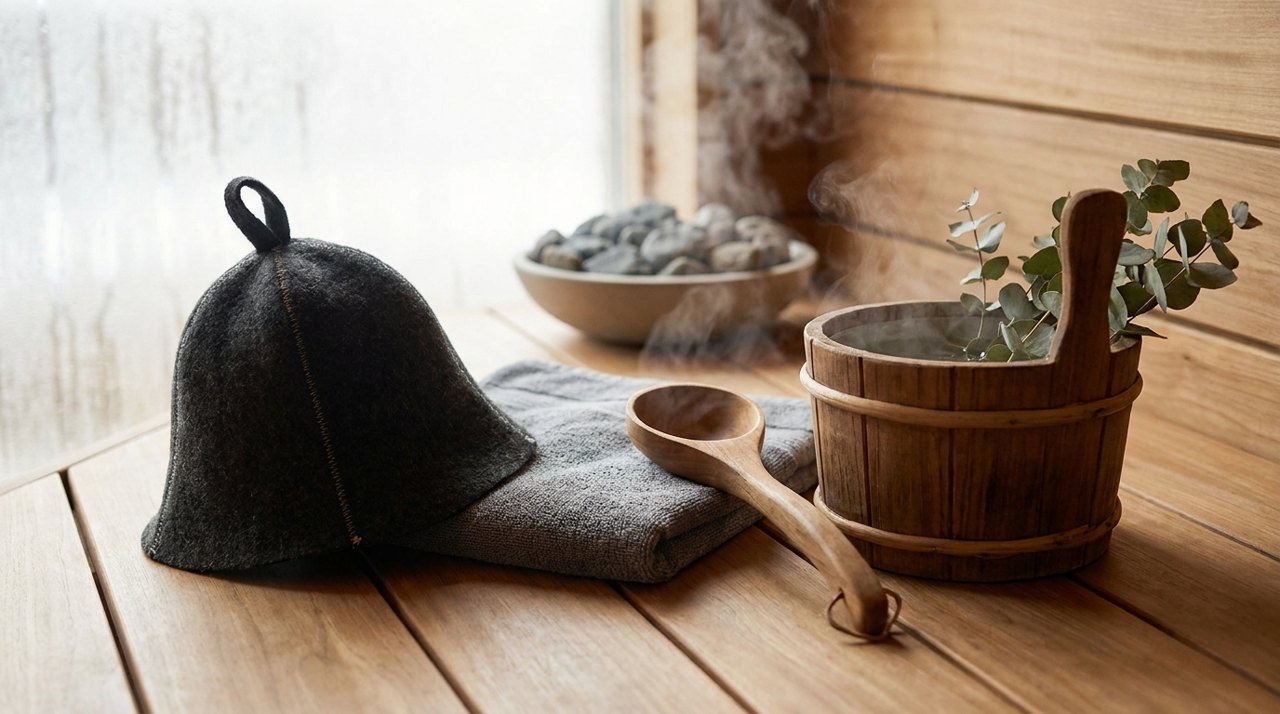
This is exactly what a sauna hat solves. A thick wool or felt hat is a low-conductivity, air-trapping insulator sitting directly on the fastest-heating part of you. It doesn't cool you — nothing in a 90 °C room cools you — it slows the rate at which your head gains heat, which pushes back the moment you start feeling that pressure behind the eyes. In practice most people find they can sit a comfortable extra round, or the same round without gritting their teeth. That's the whole mechanism, and we've written it up honestly in Why Wear a Sauna Hat?.
For a post-workout context specifically, this matters more than usual: you're already closer to your limit than you would be from rested, so anything that widens the comfortable window is worth more. The classic is dense wool felt — the a thick felt hat like this one is a straightforward example of the traditional shape, and it's also listed on Amazon if that's simpler for you. There's a wider the DIVELUX collection if you want something less plain. Whatever you buy, thickness and fit are what determine whether it works — our guide to choosing one covers the specifics.
Two gym-specific notes: rinse the hat if it's picked up sweat, and dry it flat rather than balling it in your bag. Wool handles repeat use well but not damp storage.
Timing around sleep and the next session
Heat exposure raises core temperature, then triggers a drop as you cool. That post-sauna decline is sleep-friendly — but only if it's finished before you get into bed. Aim to be out of the sauna 90 minutes to 3 hours before sleep. Finishing at 10:45 pm and lying down at 11:00 pm tends to produce exactly the restless, too-warm night people then blame on the workout.
If you train twice a day, put the sauna after the second session, not between them. Post-sauna you're vasodilated, fluid-depleted, and your ability to hit intensity is measurably lower for a while.
When to skip it
- You feel lightheaded, unusually cold-sweaty, or your heart rate hasn't settled.
- You're sick, hungover, or fighting a fever — heat on top of either is a poor trade.
- You've had alcohol. This combination is responsible for a real share of sauna deaths in Finland, and it isn't a small effect.
- You've cut weight, done a long session in the heat, or otherwise arrive already dry.
- You take medication affecting blood pressure or sweating — worth an actual conversation with your doctor rather than a guess.
A workable default
- Finish training. Cool down 10–20 minutes. Drink 400–500 ml with electrolytes.
- Shower, dry off — wet skin blunts sweating.
- Round one: 10–12 minutes, hat on, sit lower if the top bench feels aggressive.
- Cool down 10 minutes. Drink again.
- Round two: 10–15 minutes.
- Rinse, dress, eat, and replace fluids to 1.25× your measured loss.
That's it. Nothing exotic, nothing that requires believing more than the evidence supports. If you're new to the whole thing and want a checklist for your first visit, start here — the gear list is shorter than you'd think.