The most common mistake in a home sauna build isn't the heater size or the bench height — it's the last 5% of the budget. People spend months agonizing over kW ratings and cedar versus thermally modified aspen, then furnish the room with whatever showed up in a "sauna accessories" search: a plastic thermometer, a bucket that leaks, a sand timer nobody looks at. Meanwhile the things you actually touch every single session — the ladle, the towels, the headrest, the hats — get zero thought. Here's what earns its place in a home sauna, what doesn't, and the hosting details that separate a room with a heater in it from a sauna people ask to come back to.
The short list: what you'll use every session
Run a simple test on any accessory: will you physically touch it in more than half of your sessions? If not, it's decoration. By that standard, the real list is short.
- A bucket and ladle that survive heat. Wood buckets with a plastic liner are the sweet spot — the liner stops leaks and the wood stays cool enough to carry. A 4–5 litre bucket is right for a home room; 7 litres is a gym-changing-room size and it sloshes. Get a ladle with a long handle (30 cm+) so you're not reaching your forearm over the stones.
- A backrest or headrest. Cheap, transformative. A slatted aspen backrest turns the upper bench from "a plank you perch on" into somewhere you'll actually stay 12 minutes.
- Bench towels, one per person. Not for modesty — for wood. Nordic practice is that you sit on a towel or a small seat cover, always. It's the single biggest factor in how your benches look in year five.
- A thermometer and hygrometer you can read from the bench. One combined unit mounted at head height on the upper bench, not at the door. The reading at the door is fiction. If you've ever wondered why your "90 °C sauna" feels mild, that's usually why — see How Hot Is a Sauna, Really? Temperatures by Type (and Where Your Head Sits).
- Sauna hats. Yours, plus spares. More on this below, because it's the accessory most home builders skip and most regret skipping.
- A duckboard or slatted floor mat if your floor is tile or concrete. Warm underfoot, and it keeps the drip zone off the wood.
- Proper lighting. Not an accessory exactly, but dimmable and low-mounted beats a bright ceiling fixture by a mile. You want to be able to close your eyes without noticing.
Essentials vs. gimmicks
| Buy this | Skip or delay | Why |
|---|
| Wood bucket with liner + long ladle | Copper "designer" bucket | Copper looks great and burns your hand. The liner bucket costs a third as much and won't warp. |
| Combined thermo/hygrometer at head height | Digital sauna "smart" panels | Electronics in 90 °C fail. Analogue units run for a decade. |
| Bench towels + one large drying towel each | Branded "sauna kilts" for a home room | Fine in a public sauna. At home they're a laundry tax. |
| Wool or felt sauna hats | Ice buckets, aroma diffusers, LED chromotherapy | The hat changes how long you can comfortably stay. Colour-changing lights don't. |
| Birch or oak whisk (if you steam) | Whisks bought as wall decor | A dry, unused venik is a dust trap. Buy them to use, store them frozen or dried and rehydrate. |
| Stainless or wood water reservoir | Essential oils poured on stones | Neat oil on stones is a fire and fume risk. Use a few drops in the bucket water, or a stone-safe sauna scent, or nothing. |
| Sand timer or simple clock | Anything Bluetooth | Heat and humidity kill speakers and sensors. Keep the phone out of the room entirely. |
The guest hat basket: the best hosting move in home sauna
Here's the detail that costs under a hundred dollars and does more for the experience than another kilowatt of heater. Put a basket of clean sauna hats by the door, the way a good host puts out slippers.
The reasoning is practical, not decorative. Your head sits in the hottest stratified air in the room — often 15–20 °C above the reading at chest level on the lower bench. A felted wool hat slows the rate at which your scalp and ears heat up, which is why guests who'd normally tap out at six minutes will sit through a full round without fidgeting. It's the difference between people politely enduring your sauna and people enjoying it. The physics is straightforward and worth understanding once: Why Wear a Sauna Hat? The Benefits, Explained by Physics.
How to stock it:
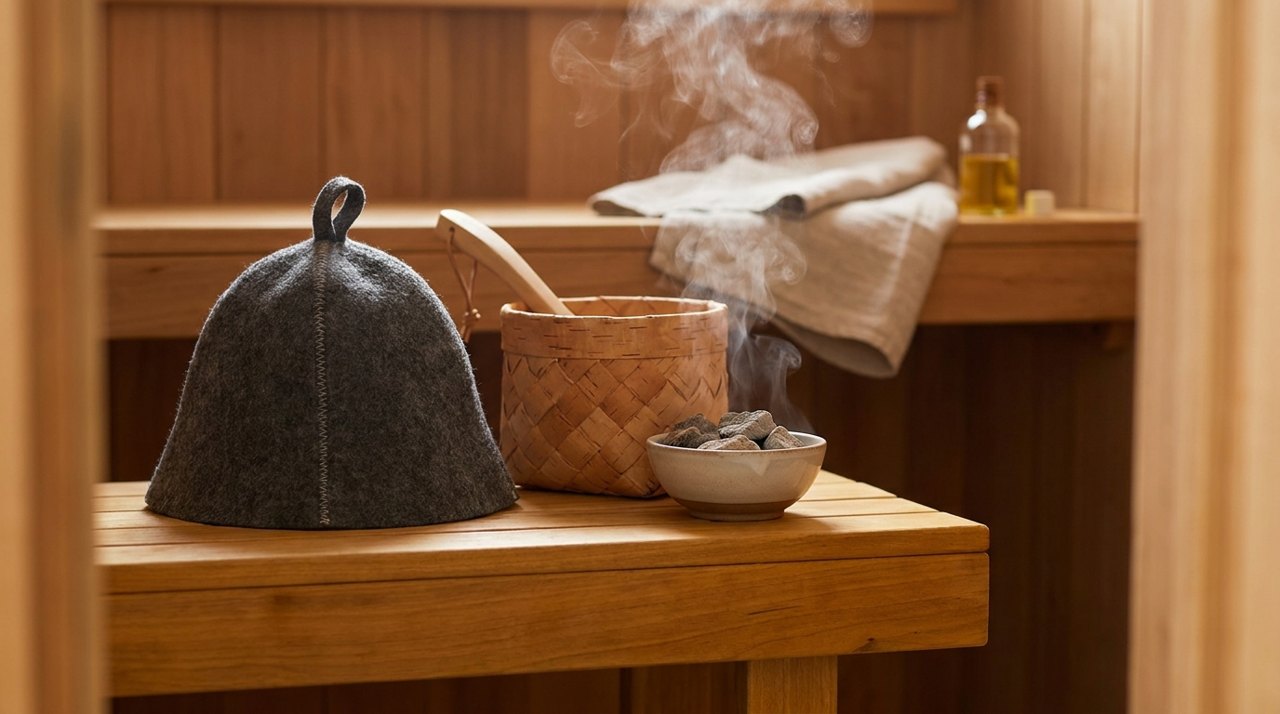
- Buy plain, buy natural wool. 100% wool felt, roughly 4–5 mm thick, undyed grey or natural white. Guest hats should be unfussy — nobody wants to be handed a novelty hat with ears on it. A classic like the DIVELUX wool sauna hat in grey is exactly the register you want; the broader DIVELUX sauna hats collection has the same shape in other colours if you want to colour-code household hats against guest hats. It's also available on Amazon if you're topping up quickly.
- Four to six is enough. Two for the household, three or four for guests. Felt hats are generously sized and forgiving on fit, so you don't need a size range.
- Keep them outside the hot room. Store the basket in the changing area or on a hook by the door — not in the sauna itself, where they'll bake and hold moisture.
- Say something when you hand one over. First-timers assume the hat is a joke. One sentence — "it keeps your head from cooking, you'll last longer" — is all it takes.
If you want a starting point for which hats hold up to repeated washing and heavy household use, our honest buyer's guide to the best sauna hats in 2026 covers the durability differences between felt densities.
Wood care: less than you think, but do it consistently
Interior sauna wood should never be sealed, varnished, oiled with a film-forming finish, or treated with anything you wouldn't want vaporising at 90 °C. That rules out most of what's on the shelf at a hardware store. What the wood actually needs:
- Ventilation after every session. Leave the door ajar and run the fan (or leave the vent open) for 30–60 minutes after you finish. Wet, closed sauna is how you get that sour smell and dark staining in six months.
- Towels on benches, always. Sweat is salty and it's what darkens bench wood. This is the whole ballgame.
- Light sanding once a year. 120-grit on the benches and backrests, ten minutes, and they look new. That's the maintenance schedule.
- Paraffin-based sauna bench oil, optional. On bench tops only, once or twice a year, thin coat, wiped back. It makes cleanup easier. Never on walls or ceiling — you want those breathing.
- Rotate and rinse the stones. Once a year, unstack the stones, discard any that are cracked or crumbling, rinse the rest, and restack loosely so air moves through. Crushed stone dust is the reason old heaters stop producing good löyly.
The hygiene routine (five minutes, weekly)
A home sauna is far cleaner than a public one, but it's still a warm, damp wooden box. The routine that keeps it right:
- Every session: shower before entering — this matters more than anything you do afterward. Sit on a towel. Air the room out when you're done.
- Weekly: wipe benches and floor with warm water and a splash of mild, unscented soap or a dedicated sauna cleaner. Rinse. Don't use bleach or anything chlorinated — it lingers in the wood and you'll smell it at full heat.
- Wash the hats. Hand-wash in cool water with wool detergent, squeeze — never wring — reshape over a bowl or a balled towel, and air-dry away from heat. Wool is naturally odour-resistant, so realistically that's every 8–10 uses for a household hat and after any session where a guest wore one. Never machine-wash on warm: felt shrinks and you'll be buying a new one.
- Monthly: pull the duckboard and clean underneath. It's the one spot that gets missed and the one spot that smells.
Build order if you're starting from zero
Bucket and ladle, then backrests, then bench towels, then hats, then the thermometer, then everything else. Total for that list is less than most people spend on a single upgrade to their heater, and it covers every physical interaction you'll have with the room. Add the guest hat basket before you add anything with a plug on it.
One last note on the hats, since they're the accessory that most often gets treated as a costume: there's a real etiquette to them, and a home sauna is where guests learn it. If you want to be able to answer "when do I take it off?" confidently, Sauna Hat Etiquette: When, Where and How to Wear One covers the conventions — including the ones that differ between a Finnish sauna and a Russian banya, which is exactly the question a curious guest will ask you on their second visit.
Related guides
Our pick: DIVELUX Wool Sauna Hat
Handmade from 100% natural wool felt. 7 colors, classic and bucket styles, one size fits most. $19.99 with free US shipping and 30-day returns.
Shop DIVELUX sauna hats →