Finland has roughly 5.5 million people, about 2.7 million registered passenger cars, and — depending on whose count you trust — somewhere north of 3 million saunas. The statistic gets repeated so often it's become a cliché, but sit with it for a second: a nation where the average household is more likely to own a hot wooden room than a vehicle. That's not a quirk of infrastructure. It's a window into how Finns think about heat, silence, family and even foreign policy.
When Finnish settlers cleared land, the sauna was traditionally the first building raised — before the house. It was sterile (or close to it, by pre-modern standards), warm, and had water on hand, so it doubled as the place where babies were born, the sick were treated, and the dead were washed before burial. For centuries, a Finn could plausibly enter the world and leave it in the same small room.
That history explains why saunas never became a luxury category in Finland the way they did elsewhere. They're plumbing, not spa treatment. New apartment blocks in Helsinki are built with shared saunas on a booking rota; many flats have small electric ones in the bathroom. Companies keep saunas for staff. The Finnish parliament has one. Burger King in Helsinki famously installed one. When the Finnish military deploys abroad on peacekeeping missions, building a sauna is close to the first order of business — there are documented tent and container saunas from Lebanon to Afghanistan.
The core of the Finnish sauna experience is löyly — the wave of steam that rises when you ladle water onto the hot stones. Dictionaries render it as "steam," which is like translating "home" as "building." Löyly originally meant something closer to spirit or breath of life, and older Finnish belief held that each sauna had its own saunatonttu, a guardian elf you did not want to offend by behaving badly in its room.
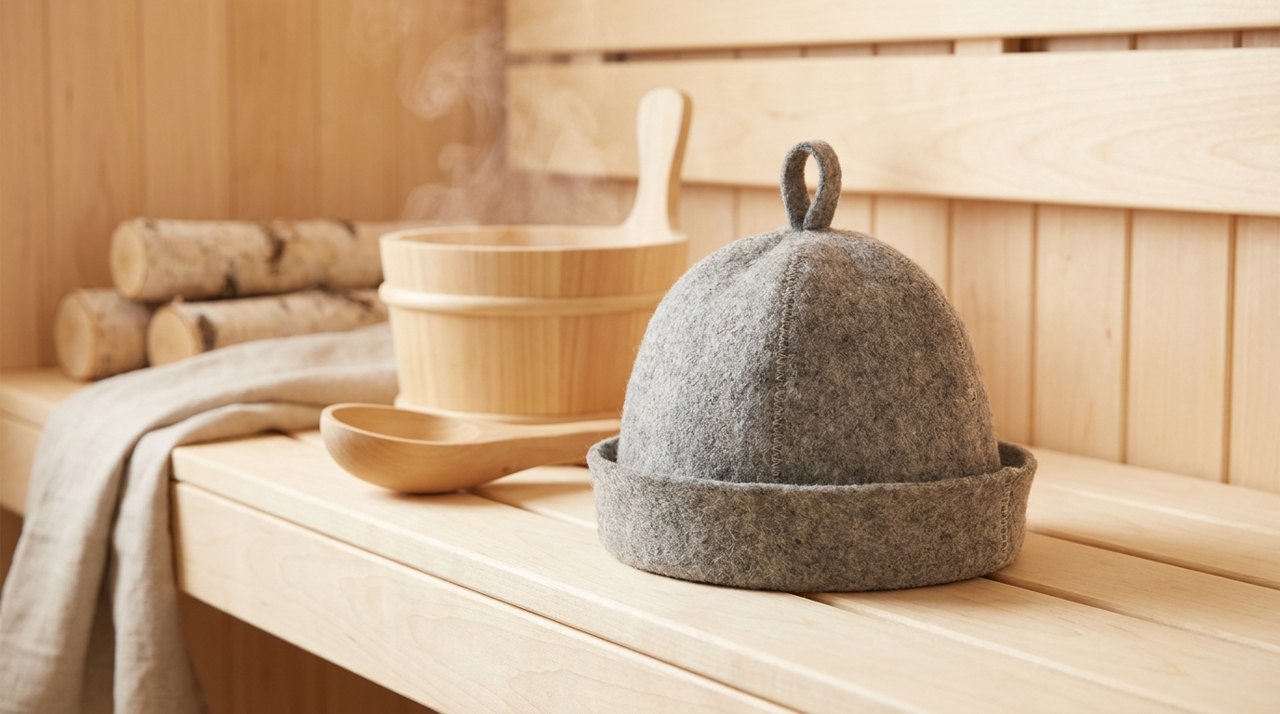
Practically, löyly is what separates a Finnish sauna from a merely hot room. The air temperature might read 80–90°C, but the moment steam hits, the effective heat on your skin spikes hard — humid air transfers heat far faster than dry air. That spike is felt first and most intensely at head height, which is exactly why Finns and their neighbors developed head protection for the sauna; we walked through the physics of that in our comparison of a covered head versus a bare one, and if you're curious how temperatures actually stack up between the bench and the ceiling, see how hot a sauna really is where your head sits. A thick felted wool hat — the classic being something like the DIVELUX wool sauna hat — insulates your head against that löyly spike so you can stay on the top bench through the wave instead of ducking or bailing early.
Finns have another famously untranslatable word: sisu — stubborn, unglamorous perseverance. The kind of grit that doesn't announce itself. The sauna ritual is a small, repeatable sisu workout: you sit in genuinely uncomfortable heat, breathe through it, then walk outside and roll in snow or drop into a hole cut in lake ice (avanto), then go back for another round.
Nobody is performing toughness here. Grandmothers do this. Kids do this. The contrast between extreme heat and extreme cold is treated as ordinary maintenance of body and mind, the way other cultures treat a morning jog. There's decent research now on heart-rate variability, circulation and mood effects from contrast bathing, but Finns didn't wait for the studies. They just noticed, over about two thousand years, that people who do this regularly feel better.
Finland has literally used the sauna as a foreign-policy instrument. President Urho Kekkonen, who led Finland through the trickiest decades of the Cold War, conducted negotiations with Soviet officials in his sauna — reportedly keeping Nikita Khrushchev in the heat until the small hours during 1960 talks. The logic is sound: nobody wears a uniform or carries notes in a sauna. Rank dissolves at 85°C. Finnish embassies around the world still maintain saunas and use them for exactly this kind of informal relationship-building; there's an official "sauna society" attached to the embassy in Washington, D.C.
The underlying rule is one every regular sauna-goer knows: conversations in the sauna are different. Slower, more honest, less performative. Finns have a saying that you should behave in the sauna as you would in church.
For most Finnish families the anchor is Saturday evening sauna. The pattern is remarkably consistent across households:
Nobody schedules against Saturday sauna. That protection — a standing appointment with heat and family that outranks everything else — is arguably the real Finnish secret, more than any detail of stove or stones.
You don't need a lakeside cabin to borrow what works. The transferable parts are structure, contrast, and protection of the time:
Finland has more saunas than cars because, for Finns, the sauna does a job no vehicle can: it's the one room where the week stops. You can build that room's habits anywhere there's heat, cold water, and an evening you're willing to defend.
Handmade from 100% natural wool felt. 7 colors, classic and bucket styles, one size fits most. $19.99 with free US shipping and 30-day returns.
Shop DIVELUX sauna hats →