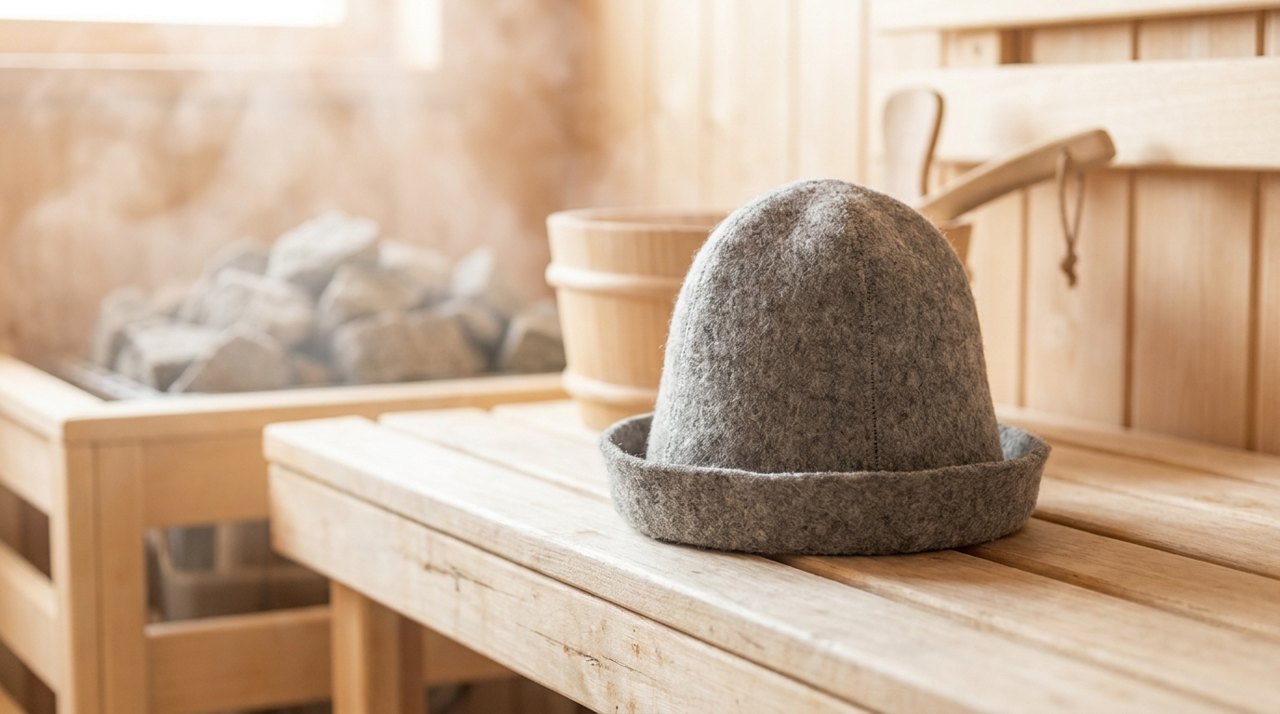
Ask for a "sauna hat" in an English-speaking shop and you'll mostly get blank looks or novelty wizard costumes. Ask for a shapka dlya bani in Moscow, a saunahattu in Helsinki or a Saunahut in Munich, and you'll be handed the exact same object: a thick felted wool dome that keeps your head cool while the rest of you cooks. The thing has one job and a dozen names, and if you've ever tried to search for one abroad — or explain to a hotel spa attendant why you're wearing what looks like a garden gnome's helmet — this glossary is for you.
The short answer
There is no single official English name. The most common search terms are sauna hat, banya hat and felt sauna cap, and they all refer to the same category: an insulating hat, usually 100% wool felt, worn inside the hot room to slow heat transfer to your head. The names split along cultural lines because the hat spread through three overlapping bathing traditions — the Russian banya, the Finnish sauna and the German-Austrian Aufguss scene — and each language community simply named it after its own bathhouse.
The glossary, language by language
| Term | Language | Literal meaning | Typical shape |
|---|---|---|---|
| Шапка для бани (shapka dlya bani) | Russian | "Hat for the banya" | Tall bell or pointed cone, often with embroidery |
| Банная шапка (bannaya shapka) | Russian | "Banya hat" | Same as above; the two terms are interchangeable |
| Saunahattu / saunalakki | Finnish | "Sauna hat" / "sauna cap" | Rounded dome, minimal decoration |
| Saunahut / Saunakappe | German | "Sauna hat" / "sauna cap" | Dome or short cone, sometimes with a brim |
| Saunamüts | Estonian | "Sauna cap" | Dome, close to the Finnish style |
| Pirts cepure | Latvian | "Bathhouse hat" | Cone or dome, often hand-felted with folk motifs |
Two clarifications worth making. First, "chapka" is a false friend: in French and English fashion writing, a chapka is the Russian fur hat with ear flaps — the ushanka — worn outdoors in winter. It comes from the same Slavic root as shapka ("hat"), which is why the confusion exists, but you would never wear fur in a 90 °C steam room. If a listing says "chapka," check the photos. Second, "banya hat" and "sauna hat" describe cultural origin, not function; a Finnish saunahattu will serve you perfectly in a Russian banya and vice versa.
Why each culture shaped it differently
The regional shapes aren't arbitrary — they track how each tradition uses heat.
- Russia: the tall cone. A banya runs extremely humid, with steam waves (par) that hit the ceiling and roll down. The classic Russian hat is tall and pointed because the extra air pocket above the crown adds insulation exactly where the hottest steam arrives first. It's also the most theatrical shape — this is where the "wizard hat" and "gnome hat" jokes come from, and Russians lean into it: hats embroidered with jokes, army stars, or "Царь" ("Tsar") are standard bathhouse gifts. The deeper history of that tradition is worth a read in our piece on the Russian banya hat.
- Finland: the plain dome. Finnish sauna culture is famously unpretentious — you're there to sit quietly and sweat, not to make a statement. The saunahattu is accordingly a simple rounded dome, usually undyed grey or white wool, fitted closer to the head. Historically it was less universal in Finland than in Russia; it has become far more common there over the past two decades, partly re-imported through Baltic felt-makers.
- Germany and Austria: the practical cap. In Aufguss saunas — where a Saunameister whips towel-driven waves of hot air directly at seated guests — the Saunahut earns its keep. German hats are often domes with a small brim to shade the face and ears from the aromatic blast. Because Aufguss sessions are communal events, hats there are as much about endurance as comfort: they let you stay through the third round of infusion without your ears burning.
If you want the mechanism behind all of this — why wool at 90 °C keeps you cooler — we've covered the physics honestly in Do Sauna Hats Actually Work?
How to ask for one abroad
If you find yourself hatless in a foreign bathhouse town, these phrases will get you understood:
- Russia / Russian-speaking countries: "Gde mozhno kupit' shapku dlya bani?" — "Where can I buy a banya hat?" Any banya with a front desk almost certainly sells them; they're an impulse-purchase staple next to the felt mitts and veniki (birch whisks).
- Finland: "Onko teillä saunahattuja?" — "Do you have sauna hats?" Try sauna supply shops, market halls, or the gift shop at any public sauna. Department stores stock them near the sauna buckets and ladles.
- Germany / Austria: "Haben Sie Saunahüte?" Thermen (thermal spa complexes) usually sell them in the lobby shop, and they're common in the sauna aisle of large sporting-goods stores.
- Estonia and Latvia: ask for a saunamüts or pirts cepure. Craft markets in Tallinn and Riga are arguably the best places in the world to buy a hand-felted hat, and prices are reasonable.
One caution for online shopping in English: search results for "sauna hat" mix genuine wool felt hats with two things you don't want. The first is costume wizard hats made of polyester — amusing, but synthetic fabric near a 100 °C ceiling is exactly what you're trying to avoid. The second is "sauna caps" of the neoprene sweat-band variety, which are designed to make your head hotter and are the opposite product. Check the fiber content: you want wool felt, ideally thick and 100%. A good benchmark for what a proper one looks like is the DIVELUX (about $20) — a classic grey Finnish-style dome in dense felt — which is also available on Amazon if you'd rather not order from a specialist shop. Their full sauna hats collection covers the other regional shapes if you want the taller Russian silhouette instead.
About those wizard hat jokes
Embrace them. Every first-timer who walks into a banya wearing a pointed felt cone gets called Gandalf, a garden gnome, or a Smurf, usually within ninety seconds. This is not mockery — it's initiation. In Russian banya culture the hat is so normalized that the joke runs the other way: the person without a hat is the odd one out, visibly unprepared for a proper steam. The novelty-embroidered hats ("Sauna Champion," "Best Steamer") exist precisely because the object sits at the intersection of genuinely functional and slightly absurd, and bathhouse culture has always been comfortable holding both.
The bottom line
Call it a sauna hat, a banya hat, a saunahattu or a Saunahut — retailers and bathhouse attendants across the sauna belt will know what you mean, and the object underneath the name barely changes: thick wool felt, dome or cone, worn in the heat. The only term to treat with suspicion is "chapka," which usually means winter fur, and the only products to avoid are synthetic costume hats and neoprene sweat caps masquerading under the same search term. If you're now deciding which one to actually buy, our guide to choosing a sauna hat breaks down material, thickness and fit in detail.
FAQ
What is a sauna hat called in Russian?
Shapka dlya bani (шапка для бани), often shortened to 'banya hat' in English.
What is a sauna hat called in Finnish?
Saunahattu. In German it is a Saunahut, in Estonian saunamüts.
Is a sauna hat the same as a banya hat?
Yes — both are thick felted wool caps worn to insulate the head in a hot room; 'banya hat' just refers to the Russian bathhouse tradition.