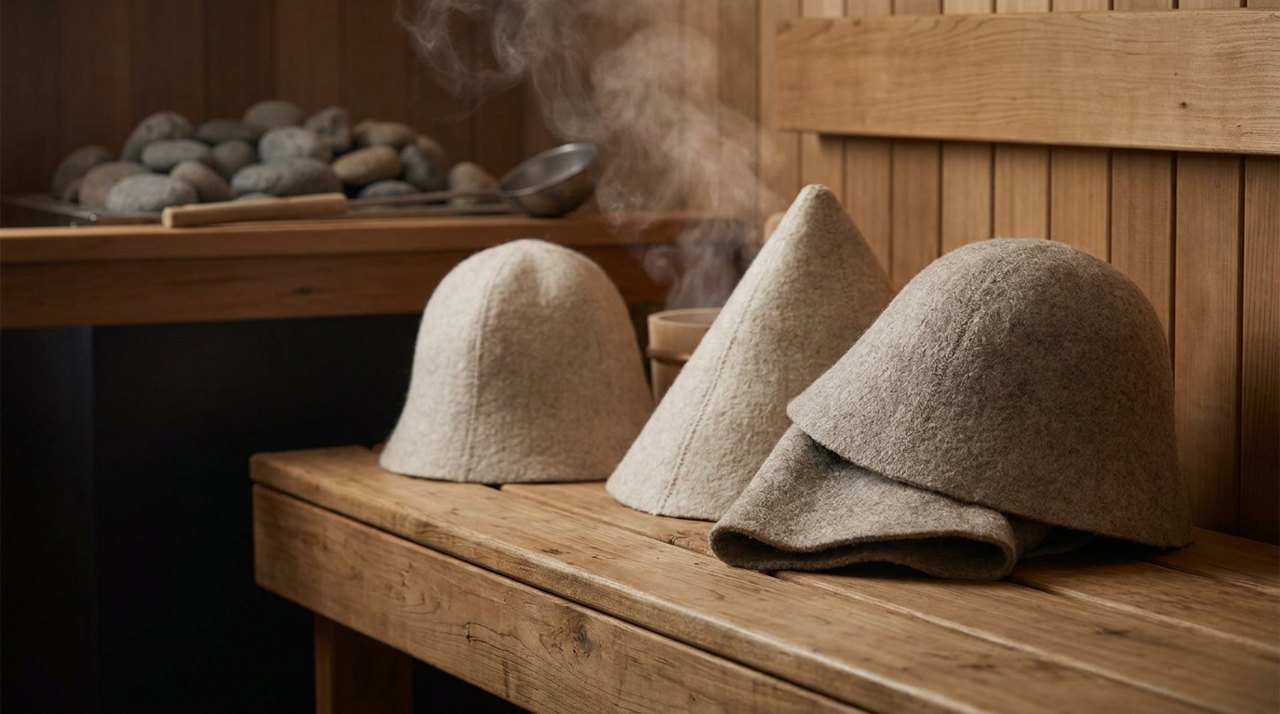
Hot tub hats are one of those ideas that sounds like a joke until the first January evening you spend in an outdoor tub. Your body is at 102°F and perfectly happy; your head is in 15°F air, wet, and radiating heat like a chimney. Sauna people solved this problem generations ago with felted wool, and the same logic transfers almost perfectly to hot tubs — with a few tub-specific caveats about splashes, sun and chlorine that are worth understanding before you buy.
Why your head is the weak point in a hot tub
A hot tub keeps your body in a narrow, comfortable band — usually 100–104°F. Your head, though, sits in whatever the air is doing. That creates two opposite problems depending on the season.
In winter, an outdoor tub in a cold climate exposes your wet scalp and ears to freezing air while the rest of you steams. Wet hair conducts heat away far faster than dry hair, and the temperature gradient between your soaking-warm neck and the cold wind is genuinely uncomfortable — it's the reason people cut winter soaks short even when the water feels perfect. Ears and the tops of ears in particular get painfully cold long before the rest of you notices anything.
In summer, the problem flips. Midday soaks mean direct sun on your face and scalp while the water keeps your core temperature elevated. Combining sun exposure with 102°F immersion is a fast route to feeling lightheaded, and a bare scalp (or a thinning one) burns quickly when it's damp.
A good hat addresses both: insulation and wind protection in winter, shade and a heat buffer in summer. It's the same reasoning behind sauna hats — we walk through the physics properly in Why Wear a Sauna Hat? — just applied to a wetter, windier environment.
Wool vs terry cloth vs a baseball cap
Three candidates come up constantly for hot tub use, and they are not interchangeable.
| Type | Winter cold | Summer sun | Splashes & steam | Verdict |
|---|---|---|---|---|
| Felted wool sauna hat | Excellent — insulates ears and scalp even when damp | Good — dense felt blocks sun and buffers heat | Excellent — sheds light splashes, keeps working when wet | Best all-round choice |
| Terry cloth hat | Poor once wet — soaks through and turns cold | Decent shade, absorbs sweat well | Absorbs everything; heavy and drippy fast | Fine for indoor tubs and mild weather |
| Baseball cap | Poor — no ear coverage, no real insulation | Good for the face, weak for ears and neck | Fine, but brim drips onto your face | Acceptable summer stopgap |
The baseball cap is the one most people already own, and for a July afternoon soak it's genuinely fine — the brim shades your face and nobody's ears are cold. But it does nothing in winter, which is when a hot tub hat earns its keep. Terry cloth feels intuitive because it's "bath material," but terry is designed to absorb water. In a splashy tub it becomes a cold, saturated sponge sitting on your head within twenty minutes — the exact opposite of what you want in February.
Why felted wool wins around water
Felted wool is the traditional sauna hat material for reasons that apply even more strongly to hot tubs. Wool fibers are naturally water-resistant on the surface — lanolin and the fiber's scale structure make light splashes bead and roll off rather than soak in. More importantly, wool is one of the few materials that keeps insulating when it does get damp. The felted structure traps air in millions of tiny pockets, and dampness doesn't collapse those pockets the way it does with cotton terry.
Felting also matters structurally. A knitted wool beanie has open loops that wick water; a felted hat is a dense, matted mass with no channels for water to travel through. Steam rising off 104°F water condenses on everything above the surface, and a felted hat shrugs that off all evening. Thick felt also holds its shape when wet, so it keeps sitting low over your ears instead of sagging.
If you're comparing specific hats, the criteria are essentially the same as for sauna use — felt density, ear coverage, fit — and our guide on how to choose a sauna hat covers them in detail. For hot tubs specifically, prioritize a hat that pulls down fully over the ears, since wind exposure is a bigger factor outdoors than in any sauna. A classic bell-shaped hat like the the grey DIVELUX hat is a good reference point for the shape and felt thickness that work: 100% felted wool, deep enough to cover ears completely, and dense enough that steam and stray splashes stay on the surface. The same hat is also available on Amazon if that's easier for shipping.
The one honest caveat: don't dunk it
A wool hat handles steam, splashes and rain. It does not handle submersion. If your hot tub routine involves going fully under, take the hat off first — a soaked felt hat is heavy, slow to dry, and chlorinated water is harder on wool than sauna humidity ever is. The hat's job is above the waterline: insulating your head while you sit neck-deep. Treat it like a winter hat that tolerates a wet environment, not swimwear.
Caring for a wool hat after chlorinated water
Chlorine and bromine are the real difference between hot tub use and sauna use. Sauna steam is just water; tub spray carries sanitizer that will gradually dry out wool fibers and strip lanolin if you let it accumulate. The routine that prevents this takes about a minute:
- Rinse after every session where the hat got splashed. Cool, clean water only — swish it briefly, don't wring or scrub. This removes chlorine residue before it dries into the felt.
- Press, don't twist. Squeeze water out between your palms or press the hat in a towel. Twisting deforms felt permanently.
- Air dry away from heat. On a shelf or over a jar to hold its shape — never on a radiator or in a dryer, both of which continue the felting process and shrink the hat.
- Occasionally, a proper wash. Every month or two of regular use, hand wash in lukewarm water with wool detergent (lanolin-enriched if you can find it), which restores some of what chlorine strips.
Skip the rinse habit and a wool hat near a chlorinated tub will stiffen and fade within a season. Keep it, and the hat outlasts the tub cover.
So: do you actually need one?
If your tub is indoors, or you only soak on mild evenings — no, a hat is a nice-to-have at most. If you soak outdoors through a real winter, a felted wool hat is the single accessory that most extends how long you can comfortably stay in, because cold ears and a freezing wet scalp are what usually end the session. And if you soak at midday in summer, a brimmed cap or a light wool hat keeps sun off your head while your core runs hot. Wool hats come in enough shapes now — bells, brimmed styles, budenovkas — that browsing something like the all seven colors will show you the range; any of them will do double duty the day you finally try a real sauna, too.
See also: DIVELUX's wool hot tub hats (bucket and classic styles, $19.99).
FAQ
Do you need a hat in a hot tub?
Not always, but in cold or windy weather a wool felt hat keeps your head warm above the water and stops heat loss, and in summer a brimmed bucket style shades your face.
What is the best material for a hot tub hat?
Felted 100% wool: it stays warm when damp, sheds splashes, dries fast and does not hold chlorine smell the way terry cloth does.
Can a wool sauna hat be used in a hot tub?
Yes — a felted wool sauna hat works well in a hot tub. Rinse it in fresh water after chlorinated or salt water and let it air-dry.