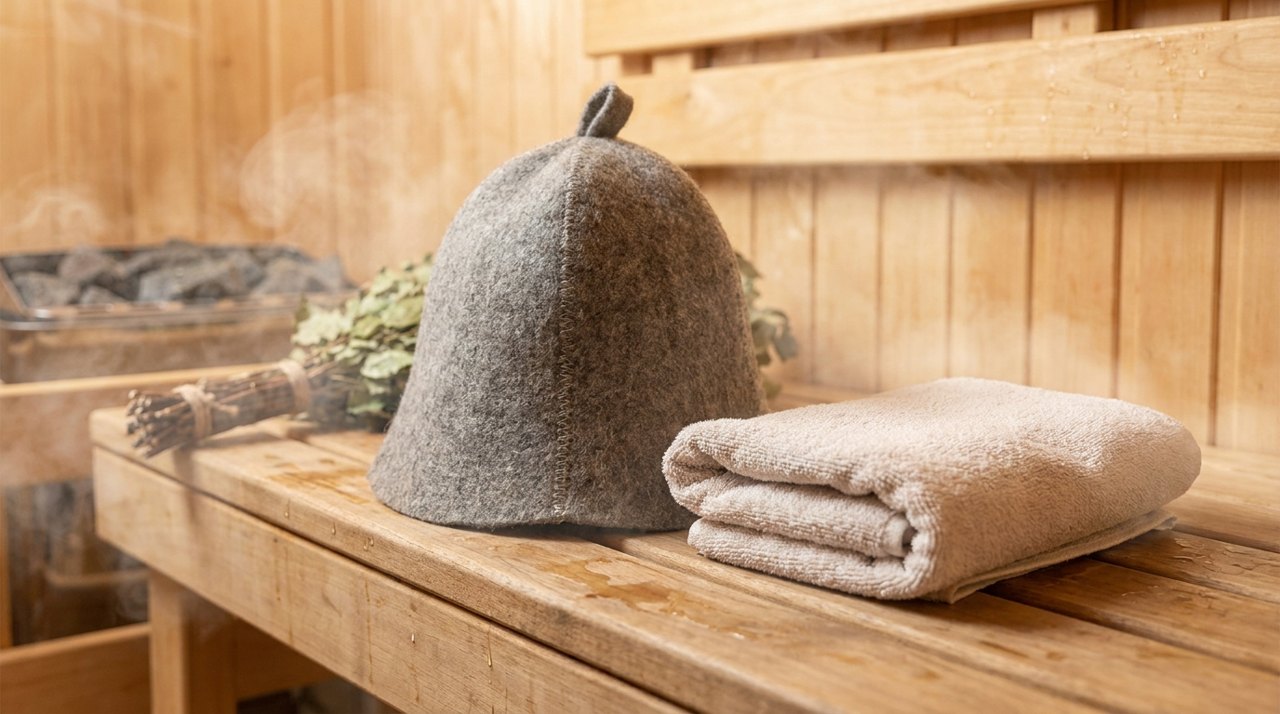
Walk into any public sauna and you'll see both camps: the person with a folded towel balanced on their head, and the person in a grey felt cone that looks like it wandered out of a fairy tale. Both are trying to solve the same problem — a head that overheats faster than the rest of the body. One of these solutions works for about four minutes. The other works for the whole session. Here's an honest comparison of the dry towel, the damp towel, and the felt sauna hat, and when each one actually makes sense.
Why your head needs protecting at all
Heat in a sauna stratifies hard. At floor level you might have 60 °C; at head height on the top bench, 90–100 °C is normal. Your head sits in the hottest layer of air in the room, it's the least insulated part of your body (thin skin, close blood vessels, often wet hair), and it's the part your brain cares most about keeping cool. That's why the first "I need to leave" signal is usually a hot scalp, throbbing ears, or light-headedness — not overheated legs. We've covered the mechanics in detail in our piece on whether sauna hats actually work, but the short version: anything that slows heat transfer into your head lets the rest of your body catch up and extends comfortable session time.
So the question isn't whether to cover your head — it's whether a towel does the job well enough that you can skip buying dedicated headwear.
The dry towel: better than nothing, briefly
A dry cotton towel folded over your head does insulate, at first. Cotton terry traps air in its loops, and trapped air is the whole game in insulation. For the first few minutes of a session, a dry towel and a felt hat perform surprisingly similarly.
Then two things go wrong.
It saturates. Your scalp sweats heavily — it's one of the densest sweat-gland regions on your body. Cotton is hydrophilic; it drinks that sweat and holds it against your head. Wet cotton is a dramatically worse insulator than dry cotton, because water conducts heat roughly 25 times better than air. Worse, that water heats up in 90 °C air. By minute six or seven, you're wearing a hot, wet compress. It's not just failing to protect you; it's actively holding heat against your skull.
It slips. A towel has no structure. Lean forward to pour water on the stones, lie down on the bench, or just turn to talk to someone, and it slides off. You spend the session doing the towel-rebalancing dance, which is exactly the kind of fidgeting a sauna is supposed to cure.
The damp towel: the myth that won't die
Some people deliberately wet the towel first, on the logic that evaporation will cool the head. This works outdoors on a hot day. It does not work in a sauna, and it's worth understanding why.
Evaporative cooling requires the surrounding air to accept moisture. In a Finnish sauna after a löyly, and especially in a steamy Russian banya, the air near the ceiling is already loaded with hot vapor. Evaporation slows to a crawl, and meanwhile you've fast-forwarded to the failure state of the dry towel: a water-soaked conductor wrapped around your head, absorbing radiant heat from the ceiling and conducting it straight to your scalp. In a proper banya at 100 °C+, a wet towel can genuinely scald. Banya regulars have known this for generations — it's precisely why the felt hat, not the wet towel, is the tradition that survived.
A damp towel has exactly one good use in a sauna: draped over your shoulders or held over your face during an aggressive steam wave. On your head for a full session, it's the worst of the three options.
The felt hat: built for exactly this job
Wool felt is what you'd design if you started from the physics. The fibers trap a thick layer of still air — felt hats run 3–8 mm thick, several times the effective insulation of a folded towel. Wool is hygroscopic rather than hydrophilic: it absorbs moisture vapor into the fiber itself while the surface stays comparatively dry, so it keeps insulating even as you sweat. And the classic wide-brimmed cone isn't decoration — it shades your ears and shields the back of your neck from radiant ceiling heat, and the structured shape stays put when you move, lean, or lie down.
Here's how the three options stack up over a realistic 15-minute top-bench session:
| Dry towel | Damp towel | Felt hat | |
|---|---|---|---|
| Insulation, minutes 0–5 | Decent | Poor | Excellent |
| Insulation, minutes 5–15 | Poor (saturated) | Actively harmful | Excellent |
| Stays on your head | Constantly slips | Constantly slips | Stays put |
| Sweat handling | Soaks through fast | Already soaked | Absorbs vapor, surface stays dry |
| Hygiene | Fine if it's your own towel | Bacteria heaven if reused damp | Airs out between sessions; occasional hand wash |
| Ear and neck coverage | Partial, if balanced right | Partial | Full, by design |
On hygiene, one point deserves emphasis: a towel that gets sweat-soaked in the sauna and then sits in a gym bag is a petri dish. A wool hat, by contrast, is naturally odor-resistant, dries hanging on a hook, and needs only an occasional gentle hand wash. A hat used twice a week will comfortably outlast years of towel laundering.
The looks question, honestly
Yes, the felt cone looks eccentric the first time. But context matters: in any Russian banya it's standard dress, in German and Eastern European saunas it raises zero eyebrows, and in Finnish and North American saunas it increasingly reads as "this person knows what they're doing" rather than "this person is odd." Meanwhile, the towel-turban wearer readjusting their headgear every ninety seconds isn't exactly projecting composure either. If the classic cone feels like too much, modern bucket-style felt hats split the difference. And check the house norms if you're unsure — we've written up the etiquette of when and where to wear one.
So: when is a towel fine, and when does a hat earn its place?
A dry towel is genuinely fine if you visit a sauna a few times a year, you sit on the lower or middle bench, your sessions run under ten minutes, and the sauna is on the milder side (under ~80 °C). In that scenario the towel's early-session insulation covers most of your exposure, and buying dedicated gear would be overkill. Bring a towel, fold it double, enjoy yourself.
A felt hat earns its place if any of these describe you: you sauna weekly or more, you prefer the top bench, you like sessions longer than ten minutes, you frequent hot Finnish saunas or steam-heavy banyas, you have long or color-treated hair (heat is brutal on it — see our long-hair protection guide), or you're simply tired of the towel slide. For regulars, the math is easy: a good hat costs about as much as two decent towels and transforms every session for years.
If you're shopping, start with 100% wool felt in the 4 mm-plus range. The DIVELUX's $19.99 classic in classic grey is a solid reference point for what proper density feels like — thick enough to insulate on the top bench, structured enough to stay on when you lean over the stones — and it's also available on Amazon if that's easier. Their their sauna hat lineup covers other colors and shapes if grey cone isn't your thing.
The bottom line: a towel is a fine loaner solution, and a wet towel isn't a solution at all. If the sauna is part of your week rather than a novelty, felt wins on every measure that matters — insulation that lasts the full session, a fit that survives movement, and hygiene that survives your gym bag.