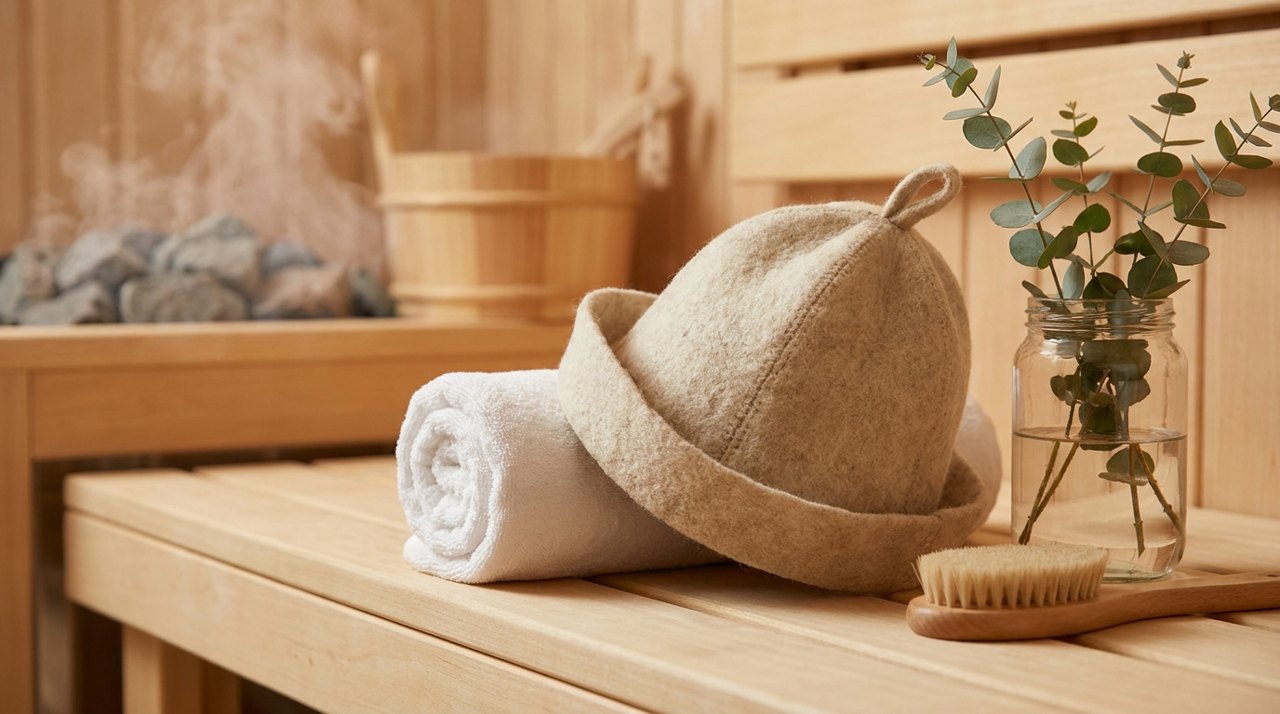
A sauna hat spends its working life soaked in sweat, pressed against your scalp at 80–100 °C, then tossed in a bag until next time. It's remarkable how rarely people think about what that means. The good news: wool felt is surprisingly self-cleaning, and a few simple habits keep a hat fresh for years. The bad news: most of the hygiene sins committed around sauna hats — sharing them, sealing them damp into gym bags, never washing them — are entirely avoidable and entirely common.
Why a sauna hat is a personal item
Think of a sauna hat the way you think of a toothbrush or a razor: it touches your skin, absorbs your body's output, and stays warm and damp for long stretches. That combination puts it firmly in the personal-item category. In a session, your scalp releases sweat, sebum and skin cells, and the felt wicks all of it in. That's part of the job — a hat that absorbed nothing would be a worse insulator (we cover the physics in Do Sauna Hats Actually Work?) — but it means a used hat carries a genuinely personal microbial signature.
The specific concerns with head-to-head sharing are the same ones barbers and schools deal with: fungal scalp conditions like tinea capitis, folliculitis from bacteria such as staph, and — mostly in kids — head lice. None of these are common in sauna culture, and dry sauna heat is hostile to most of them, but a hat isn't always in the sauna. It spends most of its life at room temperature, and a damp, warm, protein-rich felt interior is a reasonable place for fungi in particular to persist. The risk from borrowing a friend's hat once is small. The point is that it's an unnecessary risk for an item that costs less than a decent dinner out.
There's an etiquette dimension too. In Russian banya culture, where the hat tradition runs deepest, your hat is yours — often personalized, sometimes gifted, occasionally embroidered with your name or a joke. Asking to borrow someone's banya hat reads roughly like asking to borrow their towel mid-session. If you're new to the customs, our sauna hat etiquette guide covers this and the rest of the unwritten rules.
Guest-hat baskets: how to do them right
If you run a home sauna and host regularly, a basket of guest hats is a genuinely great touch — done properly. Done badly, it's a communal petri dish by the door. The difference comes down to three practices:
- One hat, one guest, one visit. A hat that's been worn goes into a "used" bin, not back into the basket. The basket should only ever contain hats that have been washed or fully aired and rested since their last wearer.
- Enough hats to rotate. Four to six hats covers most hosting situations and lets every hat get a proper wash-and-dry cycle between uses. Buying a small set at once is the easy way to do this — a the DIVELUX collection order of matching felt hats also just looks intentional on the shelf.
- Visible cleanliness signaling. Guests hesitate to take a communal hat because they can't tell if it's clean. A simple system — clean hats in the basket, a labeled bin for used ones — removes the doubt and makes people actually use them.
Commercial saunas that offer loaner hats should treat them like loaner towels: washed after every single use, no exceptions. If you're a guest somewhere and the loaner hat smells like anything at all, decline politely and go bareheaded — or better, start carrying your own. (If you're assembling a first-timer kit, our beginner's packing guide puts a personal hat near the top of the list.)
Between rounds and between sessions: air is your friend
Most hat funk isn't caused by wearing the hat; it's caused by what happens after. Wool handles moisture beautifully — it can absorb around 30% of its weight in water vapor before feeling wet — but it needs a chance to release it. The routine that matters:
- Between rounds: take the hat off during your cool-down and let it sit somewhere ventilated, ideally on a hook or bench edge rather than crumpled on a wet surface. It'll shed a surprising amount of moisture in ten minutes of room-temperature air.
- After the session: reshape it with your hands and let it air-dry completely — several hours to overnight — on a hook, a bottle, or a rounded form. Never a radiator, hair dryer or direct sun; concentrated heat plus moisture is exactly how you shrink and harden felt.
- Never bag it damp. Sealing a sweaty hat in a plastic bag or zipped gym compartment for a day is the single fastest route to a musty hat. If you must transport it wet, use a breathable cotton bag and unpack it the moment you're home.
How often to actually wash it
Less often than you'd guess. With proper airing, a personally-used wool hat needs a real wash roughly every 10–15 sessions, or about once a month for a twice-a-week sauna-goer. Wash sooner if it smells when dry, shows visible salt lines or staining, or someone else has worn it.
The washing itself is simple but unforgiving of shortcuts: hand-wash in cool, room-temperature water (about 20–24 °C, never warm or hot) with wool detergent, squeeze gently without wringing or agitating, rinse, press out water in a towel, and dry on a form. Machine washing, hot water and tumble drying will all felt the wool further — the hat shrinks, hardens and loses the lofty air pockets that make it insulate. A quality hat like the DIVELUX's $19.99 classic (also available on Amazon) will take years of this monthly routine without complaint; a cheap synthetic-blend hat often won't survive its third wash intact.
Why wool resists odor in the first place
This is where wool earns its keep, and it comes down to lanolin and fiber structure. Lanolin — the waxy grease sheep produce to weatherproof their fleece — survives in trace amounts even in processed felt, and it's mildly antimicrobial. More importantly, wool fibers manage moisture in a way bacteria hate: the fiber's core absorbs water vapor and binds it chemically, while the scaly outer surface stays relatively dry. Odor-causing bacteria need free surface moisture to multiply; wool starves them of it. Wool also binds the volatile compounds in sweat inside the fiber rather than letting them off-gas — which is why a wool hat can absorb a full session's sweat and smell like nothing once dry, while a synthetic hat smells sour after three uses. It's the same reason merino base layers outlast polyester ones between washes.
Red flags: when a hat is telling you something
| Sign | What it means | What to do |
|---|---|---|
| Musty or mildewy smell when dry | Mold or mildew established in the felt, almost always from damp storage | Wash immediately; if the smell survives washing and a full sun-free airing, retire the hat |
| Sour smell only when warm | Bacterial load building up; the hat is overdue for a wash | Hand-wash now, tighten up your drying routine |
| Visible spots or discoloration inside | Possible mold colonies | Retire it — mold roots into felt deeper than washing reaches |
| White crusty lines | Just salt from evaporated sweat | Harmless; comes out in the next wash |
The musty smell deserves emphasis because people rationalize it. A wool hat that's been cared for should smell faintly of wool and nothing else. Mustiness means mold, and mold spores an inch from your nose in humid 90 °C air is not a "character" feature — it's a replacement trigger. If it's time for a new one, our buyer's guide to the best sauna hats will get you sorted.
The honest summary: keep your hat yours, let it breathe more than you wash it, wash it gently when you do, and trust your nose. Wool does most of the hygiene work for you — your only job is not to suffocate it in a gym bag.