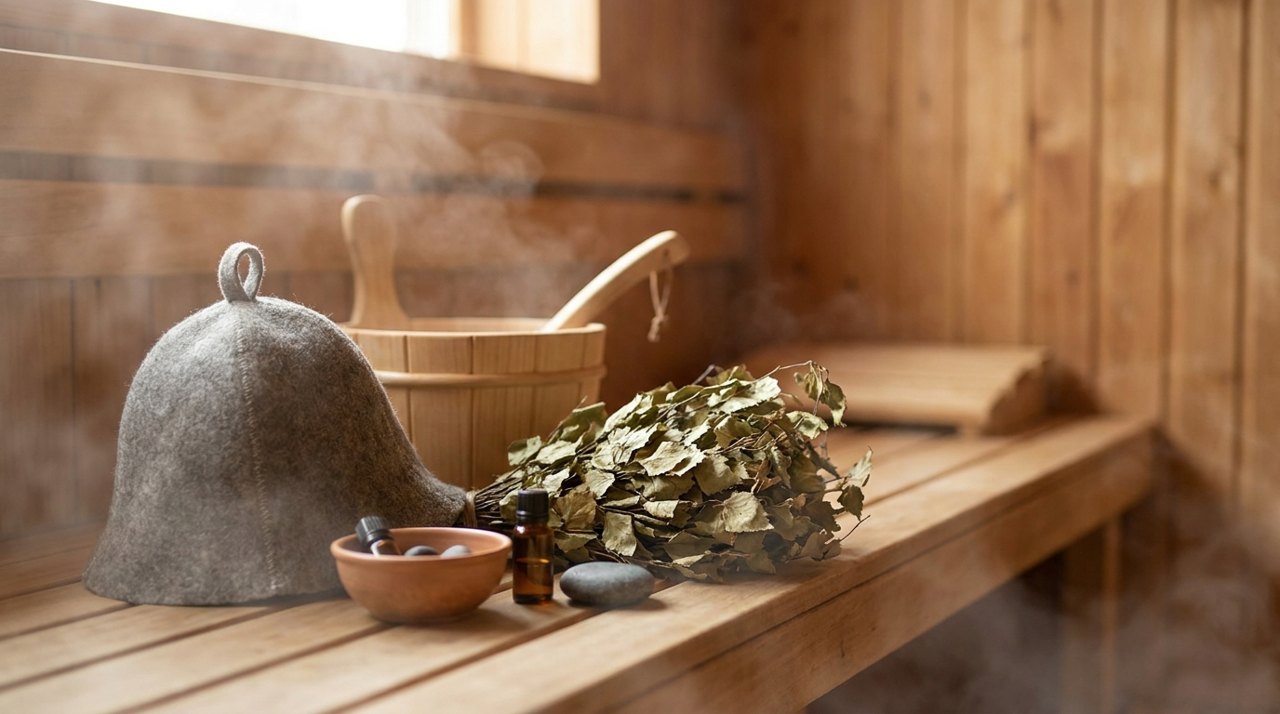
Walk into a big German thermal spa on a Saturday afternoon and you will hear it before you see it: a gong, then a hush, then a sauna door closing on forty silent people and one person holding a towel. That is Aufguss. It is part ritual, part performance and part endurance test, and it explains why so many regulars in Germany sit through the hottest part of it wearing a thick felt hat.
What "Aufguss" actually means
The word is simply German for "infusion" or "pouring on". In the sauna it refers to ladling water, usually scented with essential oils, onto the hot stones of the stove and then distributing the resulting steam through the room with a towel. Finns have poured water on stones for centuries and call the steam löyly, but the German version turned a quiet act into a structured, guided session with a start, a peak and an end.
A typical Aufguss lasts eight to fifteen minutes and comes in "rounds": usually three, sometimes four. Each round is one ladle sequence followed by towel work. Between rounds the Saunameister opens the door briefly, lets fresh air in and gives people a chance to leave. Nobody is expected to sit through the whole thing on their first visit.
Where it came from
Germany's public sauna culture grew fast after the Second World War, when Finnish saunas were imported into spas, sports clubs and municipal pools. By the 1970s and 1980s, large "Saunalandschaften" (sauna landscapes) with multiple cabins were common, and staff began scheduling infusions at fixed times so guests could plan around them. The towel waving came from a practical need: in a room with forty people, steam that just sits above the stove reaches nobody. Fanning it around made the heat even and turned the pourer into a host. Somewhere in the 1990s the host became a performer, and the show Aufguss was born.
Today most German spas post a printed Aufguss timetable at the entrance like a train schedule. Big venues run twenty or more sessions a day across different cabins, each with its own theme, oil and temperature. If you want to understand how this fits into the wider picture of bathing traditions, our overview of sauna culture around the world puts Germany next to Finland, Russia and Korea.
The Saunameister
The person running the session is the Saunameister (or Saunameisterin). In Germany this is a real job with a recognized training path through the Deutscher Sauna-Bund, the national sauna association. A good one manages three things at once: the heat curve of the room, the safety of the guests and the mood.
- Heat control. They decide how much water goes on the stones, how often and how hard the towel is worked. A cabin at 85 °C can feel like 110 °C at head height during a strong round.
- Watching the room. A trained Saunameister scans faces constantly. Pale skin, glassy eyes or someone slumping forward means they will quietly open the door.
- The story. Many introduce the oils, explain the theme and set a tone, from meditative to loud and playful.
The oils
The scent is not decoration. Most Saunameister carry a case of concentrated essential oils and choose based on time of day and the mood they want. Common choices:
| Oil | Typical use | What it feels like |
|---|---|---|
| Eucalyptus, mint | Morning, "wake-up" sessions | Sharp, cooling on the skin even as the heat rises |
| Citrus, orange, lemongrass | Midday, family sessions | Bright, light, easy for beginners |
| Pine, fir, birch | Classic "forest" rounds | Resinous, close to a Finnish or Russian steam room |
| Lavender, vanilla, sandalwood | Evening, quiet sessions | Heavy, sweet, sits low in the room |
A few drops go into the ladle bucket, never directly onto the stones, because pure oil can flash and burn. Some sessions add ice balls infused with oil, which melt slowly on the stove and give a longer, gentler release of scent. Salt or honey scrubs are sometimes handed out between rounds for a "Peeling-Aufguss".
Towel technique
This is the part people film. The standard tool is a large, dry bath towel, and the moves have names within the community:
- The helicopter. The towel is spun overhead to pull hot air down from the ceiling and mix it through the room.
- The pizza or plate. The towel is held taut and pushed toward a single guest or row, delivering a wall of heat to one place.
- The whip or snap. A fast flick that sends a concentrated pulse of hot air. This is the move that makes people gasp.
- The fan. Slow, wide sweeps used to even out temperature between top and bottom benches.
The physics is simple: hot, humid air stratifies, and the top of the cabin can sit well above the thermometer reading. The towel moves that layer onto people. Our piece on how hot a sauna really is goes into why the reading on the wall understates what your head experiences.
Etiquette for guests
Aufguss has stricter rules than an ordinary sauna sit, and Germans will tell you if you break them. The essentials:
- Be there before it starts. The door closes when the gong sounds, and late entry is not allowed. Arriving early also gets you a lower bench if you want a gentler experience.
- Textile-free is the norm. In German spas, swimwear is banned in the sauna itself. You sit on a towel, with no skin touching the wood, and carry a second towel to dry off.
- Do not talk. Once the round begins, the room is silent except for the Saunameister and the music, if any.
- Leaving is fine, between rounds. Stand up when the door opens, not during a towel sequence. Raising a hand quietly is the signal if you need out immediately.
- No pouring your own water. During a scheduled Aufguss the stove belongs to the Saunameister.
- Applause at the end is normal and expected. Then everyone files out to the cold showers and plunge pools.
If you are new to public saunas in general, our guide on what to bring and expect your first time covers the basics before you tackle a full Aufguss.
Show Aufguss and the championships
Around the 2000s, the ritual split into two branches. "Classic Aufguss" stays simple: scent, heat, silence. "Show Aufguss" adds costumes, lighting, a soundtrack and a storyline, with the Saunameister acting out scenes while working the towel to the music. Think Pirates of the Caribbean at 90 °C.
The competitive version is organized under the Aufguss WM, the world championship run by the international association Aufguss-WM. National qualifiers feed into a final that has been held in Germany, the Netherlands, Italy and Poland, with single and team categories. Judges score on scent composition, towel technique, heat distribution, storytelling and how well the performer manages the audience. Winning routines run around fifteen minutes and are rehearsed for months. It sounds absurd until you have sat through one and realized you forgot how hot it was because you were watching a man in a wizard robe throw a towel in perfect time with an orchestra.
Why the regulars wear felt hats
Look around during a hard third round and you will notice a pattern. Many of the people sitting calmly on the top bench are wearing thick wool or felt hats, the same style as a Russian banya hat. This is not costume. It is how experienced bathers survive the peak of an Aufguss without the throbbing head that drives beginners out.
The reasoning is straightforward. Your head and face carry a dense network of blood vessels close to the skin, and a towel snap delivers a pulse of air hotter than anything on the thermometer. Felt is a poor conductor and traps a layer of still air, so the temperature at your scalp rises much more slowly than the room. Your body still sweats and gets the full effect; your head just stops being the first thing that gives up. We break down the mechanism properly in why wear a sauna hat, explained by physics.
The hat that works best for Aufguss is dense, dry wool felt with a wide brim or a tall crown, so it stands off the scalp rather than clinging. A classic option is the this handmade wool felt hat, a plain grey felt in the traditional shape that you will see on plenty of German top benches. The classic and bucket styles has other cuts if you want something with more crown height for long hair, and the same grey hat is also available on Amazon if you are ordering outside Europe.
One practical note: keep the hat dry for Aufguss. Water in the felt heats up fast under the towel waves and kills the insulating effect; dry felt is full of trapped air, and that air is what shields your head. Dry felt, pulled low over the ears, is what the regulars do.
Is it worth seeking out?
Yes, with one caveat. A well-run Aufguss is the most intense and most social sauna experience you can have in Europe, and almost every large German spa runs them all day for no extra charge. Go early, sit low the first time, leave between rounds if you need to, and do not be surprised if you come back an hour later wearing a hat.