Losing your hair changes the sauna in a way nobody warns you about. The heat that used to sit on top of a natural insulating layer now lands straight on skin, and sweat that used to soak into hair now runs in a clean line into your eyes. A felt hat solves both problems, but a shaved head also has its own fit and care quirks that most sauna hat advice skips. This guide covers what actually changes when you go bare-scalped, and how to fix it.
What hair was quietly doing for you
Hair is not a great insulator by textile standards, but it does two useful things in a hot room. First, it traps a thin layer of still air between the scalp and the ambient heat. Still air is one of the better insulators around, which is exactly why felt works. A full head of hair adds maybe a few millimetres of that buffer. Second, hair absorbs and spreads sweat across a wide surface, where it evaporates and cools the head before it can drip anywhere.
Take the hair away and both effects vanish. The scalp is now the highest point in the room, facing the ceiling where the hottest air pools, with no buffer and no sweat management. If you want the numbers on how much hotter head height really is, our temperature guide breaks it down by sauna type. The short version is that on the top bench your head can sit 15 to 25 °C hotter than your feet.
Why a bare scalp feels the heat more
Skin that has been covered for years, or that is freshly shaved, behaves a lot like skin that got sunburned yesterday. It is not damaged, but it is unaccustomed to direct exposure and reacts to heat quickly. Most bald sauna-goers describe a tight, prickling sensation on the crown within the first few minutes, well before the rest of the body feels uncomfortable. That is your scalp telling you it has hit its comfort limit while your core is still nowhere near done.
A few reasons this happens:
- Blood supply. The scalp is richly supplied with vessels close to the surface. It warms fast, and a warm scalp sends a strong signal to the brain that the whole body is overheating.
- Radiant heat. Sauna stones and heaters radiate infrared, not just hot air. A smooth scalp facing the heater absorbs radiant energy directly. Hair scattered and partially reflected it.
- No evaporation buffer. Sweat on a bare scalp beads and runs off rather than spreading and evaporating. You lose the cooling effect and gain a drip problem.
- Shaving irritation. A scalp shaved that morning has micro-abrasions. Salt sweat at 90 °C on freshly shaved skin stings in a way that is hard to ignore.
The result is a shorter session, not because you are done but because your head is. That was the whole reason banya-goers started wearing felt caps centuries ago, and the physics behind the sauna hat explains why the fix is so effective.
The sweat-in-the-eyes problem
This one is almost universal among bald sauna users. Sweat starts at the crown, gathers momentum down a smooth forehead with nothing to slow it, and arrives in the eyes as a salty stream. Wiping with a towel works for about thirty seconds. Eyebrows help a little, but not enough.
A felt hat fixes this from two directions. The wool absorbs sweat at the source before it can run, and the brim or lower edge acts as a dam across the forehead. A hat that sits properly, meaning brim edge just above the eyebrows, catches almost everything. This is a bigger quality-of-life improvement than the temperature difference for many people. Sitting still with your eyes open, actually relaxing, is the whole point.
Why felt and not a towel or a cotton cap
People try alternatives before buying a proper hat. Here is how they compare on the things that matter to a bare scalp.
| Option | Insulation | Sweat control | Stays put | Comfort on bare skin |
|---|---|---|---|---|
| Nothing | None | Sweat runs straight into eyes | n/a | Scalp overheats first |
| Towel wrap | Moderate while dry, poor once soaked | Good until saturated | Slips constantly on a smooth head | Fine, but heavy when wet |
| Cotton cap | Low | Soaks through fast, then drips | Reasonable | Cool at first, clammy later |
| Wool felt hat | High, and stays high when damp | Absorbs a lot, brim dams the rest | Good with the right size | Soft, breathable, no clamminess |
Felt wins because wool insulates even when it is holding moisture, and because a shaped hat holds its position on a head with no hair to grip. The towel-versus-hat question gets a fuller treatment in our towel comparison, but the slipping issue alone usually settles it for bald users.
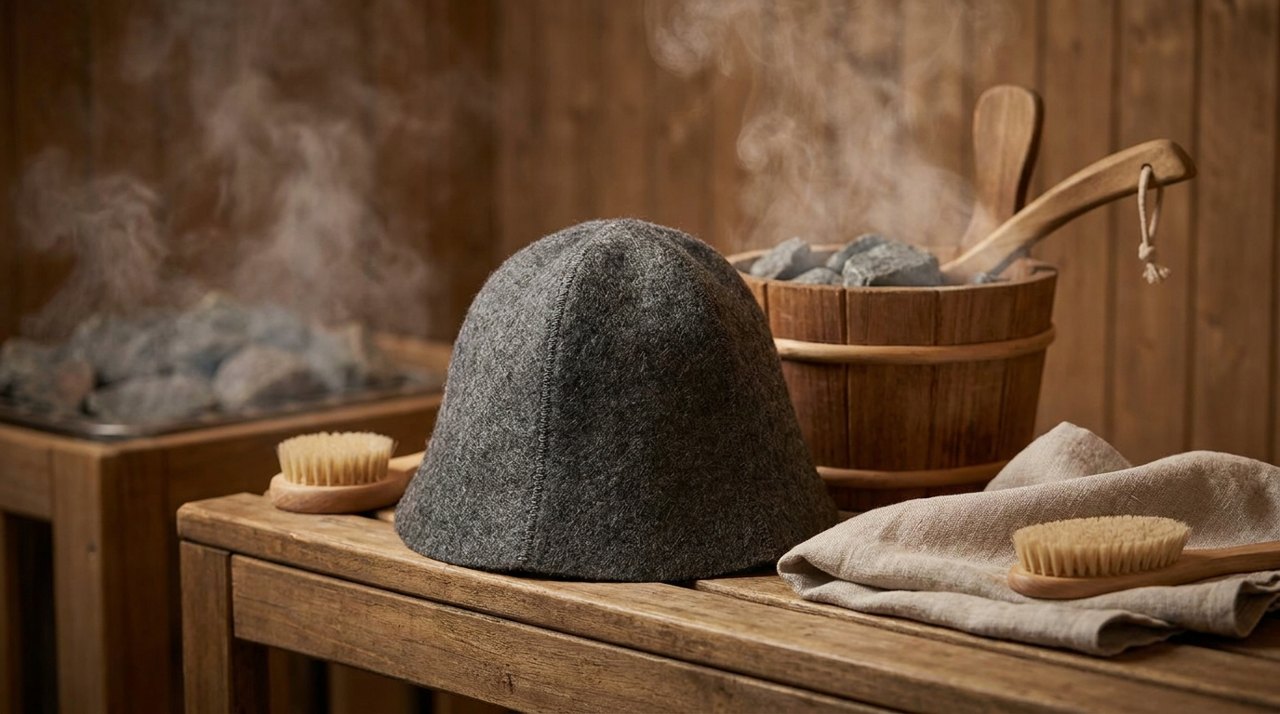
The a 100% wool hat such as DIVELUX is a good example of the classic shape done properly. It is thick 100% wool felt, tall enough to leave an air gap above the crown, with a brim that sits right where you want a sweat dam. It is also available on Amazon if that is easier for you.
Fit notes for a shaved head
Most sizing advice assumes hair is filling some of the space. Without it, a few things change.
- Measure, do not guess. Wrap a tape around your head about a centimetre above the eyebrows and ears. A bald head measures smaller than the same head with hair, sometimes by a full size. Most adults land between 56 and 60 cm.
- Prefer a snug band, not a tight one. There is no hair to create friction, so a loose hat will ride up as you move and lean back. Aim for a band that stays put when you tilt your head forward but leaves no pressure line after ten minutes.
- Keep the air gap. The insulation comes from the space above your crown, not from felt pressed against skin. A tall or slightly domed hat is better than a shallow one that hugs the scalp.
- Check the inside seam. Cheaper hats have a raised inner seam that hair would normally cushion. On bare skin it can leave a red line. Run a finger around the inside before buying. Good felt hats are seamless or have a flattened seam.
- Wear it dry. Dry felt is full of trapped air, and that air is what shields a bare scalp from the heat. More on why the hat should stay dry.
If you shave rather than simply being bald, do it the night before, not the morning of. Fresh razor burn plus salt sweat plus 90 °C is a combination nobody enjoys, hat or no hat.
Quick care routine for a hat that touches bare skin
A hat on a bald head absorbs more sweat than one worn over hair, because every drop goes into the felt rather than the hair. It needs a little more attention as a result.
- After every session: rinse the inside band with cool water and squeeze gently. Do not wring. Shape it and let it dry on a bottle or bowl, away from direct heat.
- Weekly if you sauna often: hand wash in cool, room-temperature water with a drop of wool detergent. Press dry in a towel, reshape, air dry.
- Every few weeks: hang it outdoors for an hour. UV and fresh air do more for odour than any spray.
- Never: machine wash, tumble dry or leave it on the sauna bench to dry. Felt shrinks and hardens with heat and agitation, and a shrunk hat on a bald head fits nobody.
Treated this way a good felt hat lasts for years. If yours is a shared or public sauna, keep it personal and never lend it out. A bare scalp is more prone to picking up irritation from someone else's sweat than a hairy one, and the hygiene side has its own article for anyone who wants the detail.
The bottom line
Being bald does not mean the sauna is less for you. It means the hat that many hairy people treat as optional becomes the piece of kit that lets you sit as long as everyone else, with your eyes open and your scalp comfortable. Start with a classic tall felt shape in your measured size, wear it dry, and rinse it after every session. If you want to see the range of shapes and colours, the the DIVELUX collection covers the classic, the bucket and a few in between. For a broader comparison across brands, our 2026 buyer's guide ranks them honestly.