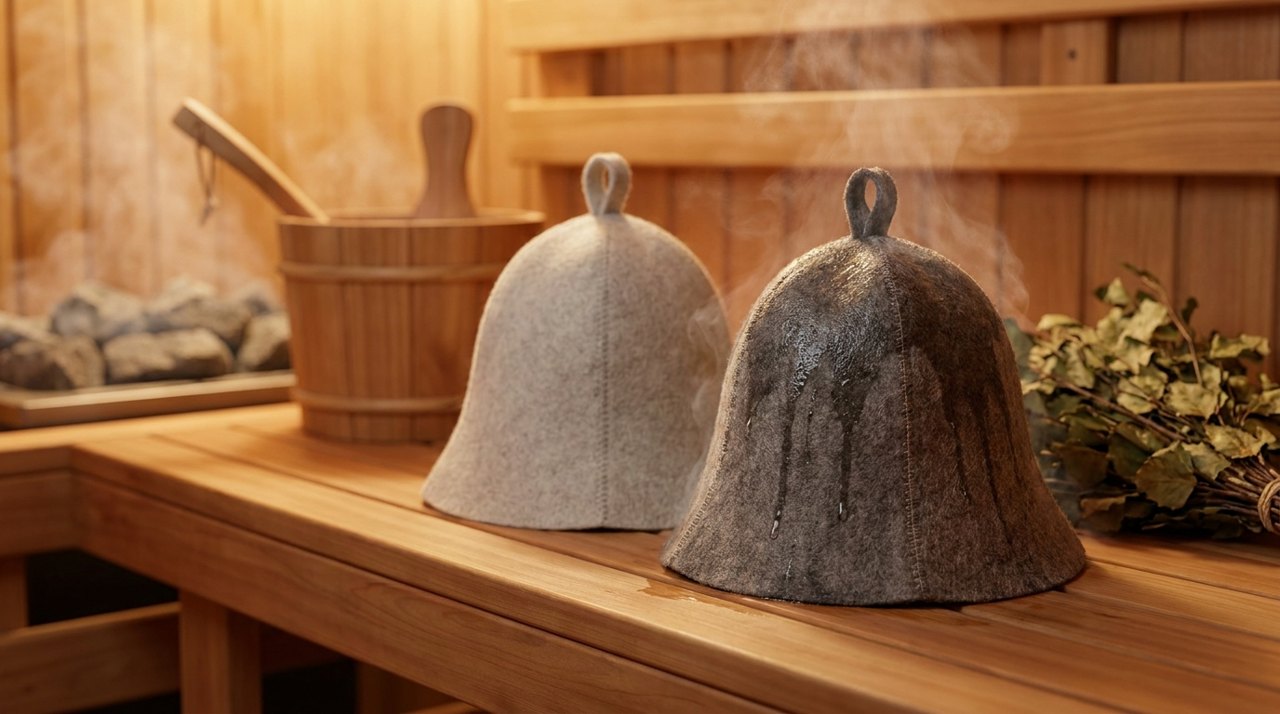
Somewhere online you'll find the advice to soak your sauna hat in cold water before you climb to the top bench. Skip it. A wool sauna hat is meant to be worn dry, and the reason is simple physics: dry felt is full of trapped air, and that trapped air is what keeps the heat off your head. Water pushes that air out. Here's what a dry hat actually does, why wetting it works against you, and how to keep it dry and in shape for years.
What a dry hat does: insulation that lasts the whole round
A dry wool felt hat works the same way a house's loft insulation does. Felt is a tangle of wool fibers trapping millions of tiny air pockets, and still air is a terrible conductor of heat. With a sauna running at 80–100 °C at head height — and your head really does sit in the hottest layer of the room, as we covered in our temperature-by-type breakdown — that trapped air slows the flow of heat toward your scalp and ears dramatically. The surface of the hat gets hot; the inside stays close to skin temperature.
That protection doesn't run out halfway through a session. For a typical 10–15 minute round, a dry hat keeps your head comfortable, shields your hair and ears from radiant heat, and lets you sit as long as the rest of your body wants to. If you want the deeper physics of why this matters at all, we've written up the honest answer on whether sauna hats work.
Why a wet hat works against you
The idea behind soaking is that cold water will cool your head as it evaporates. In practice, it trades a reliable insulator for a short-lived cold compress:
- Water replaces the insulating air. Wet wool conducts heat far better than dry wool. A soaked hat stops being a barrier and becomes a warm, wet layer pressed against your scalp.
- The cold doesn't last. Whatever chill the water brings is gone within minutes at sauna temperatures. After that you're left with a heavy, warm, damp hat for the rest of the round.
- Steam can feel hotter. When löyly hits a wet surface on your head, the heat arrives faster than it would through dry felt. Dry wool takes that wave of steam much more gently.
- Drips and discomfort. Water running into your eyes and down your neck is the opposite of relaxing.
Your hat will still take on some moisture from sweat and steam during a session — that's normal, and wool handles it well. The point is not to add water on purpose. Put the hat on dry, and keep it dry between rounds.
Does the type of sauna change the answer?
No. Whatever the room, the hat does its best work dry. What changes is mostly how hot the air at head height gets:
| Room type | Typical conditions | How to wear the hat |
|---|---|---|
| Finnish dry sauna | 80–100 °C, 10–20% humidity | Dry — this is exactly the heat felt was made for |
| Finnish sauna with löyly | 75–90 °C, humidity spiking with each ladle | Dry — dry felt softens each wave of steam |
| Russian banya | 60–80 °C, 40–70% humidity | Dry — pull it low over the ears for the steam and the venik |
| Steam room / hammam | 40–50 °C, ~100% humidity | Dry when you put it on; mostly about comfort and hair protection here |
| Infrared cabin | 45–60 °C, low humidity | Dry, or skip it — temperatures are mild |
A useful rule of thumb: the hotter the room, the more a dry hat earns its place. The banya, with its long, steamy, physical sessions, is where felt hats have their deepest roots — the banya hat's history is worth a read on its own.
Keeping your hat dry and in shape
A dense, well-felted hat like the DIVELUX (about $20) (also available on Amazon) keeps its shape and its insulation for years if you look after it. If you're weighing options, the all seven colors covers the standard shapes, and our 2026 buyer's guide compares the wider market honestly.
What does kill felt hats is bad drying and bad washing. The rules are short:
- Hang it up after every session. Let the sweat it picked up air out on a hook, not crumpled in a bag.
- Wash by hand when it needs it. Cool water and a little wool soap, then press — never twist — the excess out.
- Reshape it after washing. Felt dries into whatever shape it's left in. Pull it back to form with your hands or dry it over a bowl.
- Air-dry away from direct heat. Not on the sauna stove, not on a radiator, not in a dryer. Heat plus moisture plus agitation is literally the felting process — it will shrink and harden the hat.
- Let it dry fully before storing. A damp hat in a gym bag grows mildew.
FAQ
Should I wet my sauna hat before going in?
No. Wear it dry. Dry wool felt traps air, and that air is what insulates your head from the heat; soaking the hat pushes the air out and turns it into a warm, wet layer on your scalp.
Doesn't a wet hat keep your head cooler?
Only for a minute or two. The cold water warms up fast at sauna temperatures, and after that a wet hat insulates worse than a dry one. A dry hat protects you for the whole round.
What about a Russian banya or a steam room?
Same answer: put the hat on dry. Dry felt handles waves of steam better than wet felt, and in a steam room the hat is mainly about comfort and keeping hot moisture off your hair.
My hat gets damp from sweat. Is that a problem?
No. Wool handles sweat well. Hang the hat up to air-dry after the session, and wash it by hand in cool water when it needs a refresh.
The honest bottom line
Wear your sauna hat dry. Dry felt is the best insulator you can put between your scalp and 90 °C air, and it keeps working for the whole round, in any kind of sauna. Skip the soaking, hang the hat up to air out afterwards, and wash it by hand only when it needs it. And if you're still deciding whether a hat belongs in your kit at all, here's what actually changes when you wear one.