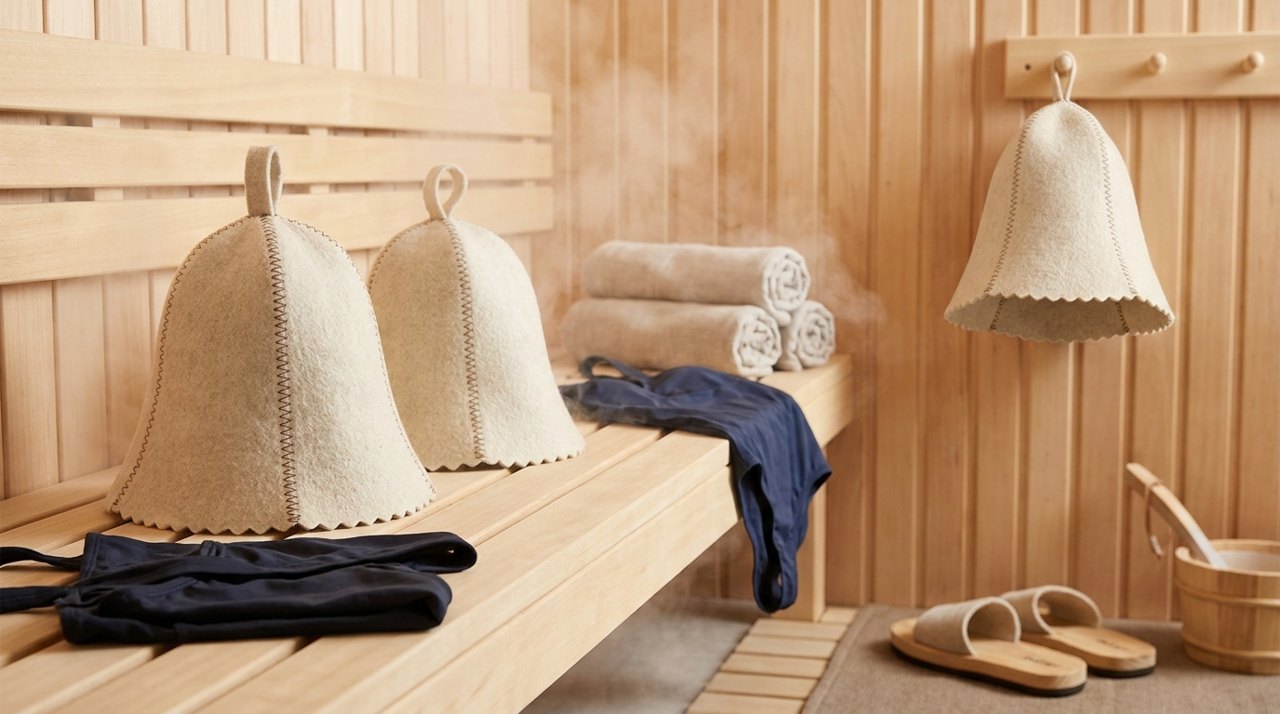
The honest answer to "what do I wear in a sauna?" is: as little as possible, and nothing synthetic. But the details depend entirely on where you are. A Finnish public sauna, a German therme, a Russian banya and an American gym sauna all have different — sometimes opposite — dress codes, and showing up wrong is the fastest way to feel like a tourist. Here's how each culture handles it, why some fabrics and accessories genuinely don't belong in 90°C air, and what to actually pack.
The two big traditions: towel-only vs swimsuit
Sauna dress codes split roughly into two camps, and neither considers itself optional.
Towel-only (nude) cultures. In Finland, Germany, Austria and much of Central Europe, saunas are traditionally taken nude, sitting or lying on a towel. In German-speaking countries this is often enforced: many thermal spas post "textilfrei" signs, and wearing a swimsuit into the sauna will get you corrected by staff or fellow bathers. The logic isn't exhibitionism — it's hygiene and physiology. A wet swimsuit traps sweat and chlorine against your skin, drips pool water onto the benches, and interferes with the whole point of the exercise, which is unobstructed sweating. The towel is the non-negotiable item: you sit on it so your skin never touches the wood, feet included in the strictest houses.
Swimsuit cultures. In the US, UK, most hotel and gym saunas worldwide, and mixed-gender public facilities in many countries, swimwear is required. Russian public banyas are usually single-gender and nude, but mixed commercial ones expect a swimsuit or a wrap. Korean jjimjilbangs split the difference: the hot soaking pools are nude and gender-separated, while the communal sauna rooms are used in facility-issued cotton pajamas.
The rule of thumb: read the signage, watch what locals do, and when in doubt ask at the front desk. Nobody minds the question; everybody minds the person who guesses wrong. For a deeper tour of how these traditions differ, see our guide to sauna culture around the world.
Why synthetics are a genuinely bad idea
This isn't etiquette snobbery — there are physical reasons to leave polyester outside the hot room.
- Heat retention and off-gassing. Synthetic fibers like polyester, nylon and elastane are plastics. At typical sauna temperatures of 80–100°C they won't melt (most tolerate 150°C+), but they get uncomfortably hot against skin, and cheap prints, coatings and glued logos can soften and release odors. Metal or plastic hardware — zippers, clasps, drawstring tips — heats up faster than the fabric around it.
- Blocked sweating. Tight synthetic swimwear doesn't breathe. Sweat pools underneath it instead of evaporating, which is both unpleasant and counterproductive.
- Chlorine chemistry. A suit that's been in a chlorinated pool carries chlorine into the hot air, where it evaporates off you. In a small cabin, everyone smells it.
If a swimsuit is required, the best choice is a simple one: plain cotton or mostly-cotton if allowed, or an untreated synthetic suit that has been rinsed in fresh water first, with minimal hardware.
Jewelry: take it all off
Metal conducts heat about 400 times better than air. A ring, watch, necklace or piercing that feels neutral at room temperature becomes a small branding iron at 90°C — surface burns from wedding rings and necklace chains are a genuinely common sauna complaint. Beyond comfort, heat and sweat accelerate tarnishing on silver and can degrade the adhesives in fashion jewelry, and glasses frames get hot enough to be unpleasant on the nose bridge (contact lens wearers should note that dry heat can be uncomfortable too — many just squint happily). Leave watches, fitness trackers and phones in the locker; most aren't rated for sustained 90°C heat anyway, and batteries hate it.
Feet: bare inside, sandals outside
Footwear follows a simple boundary rule almost everywhere:
- Inside the hot room: bare feet. Shoes and flip-flops track dirt onto the benches and floor, and rubber soles get hot and smelly. In towel-strict cultures, you place a corner of your towel under your feet as well.
- Everywhere else: sandals. The wet walkways between showers, pools and sauna are exactly where athlete's foot spreads. A pair of simple rubber or cork slides is standard kit in Finnish public saunas, German thermes and gym locker rooms alike. Take them off at the sauna door, line them up outside — the row of abandoned sandals is how you know a sauna is busy.
Where the wool hat fits in each dress code
Here's the paradox that surprises first-timers: the one garment that's welcome in every sauna culture, including strictly nude ones, is a hat. A thick felted wool sauna hat insulates your head — the part of you closest to the ceiling, where the air is hottest — so your scalp, ears and hair stay cooler while the rest of you sweats freely. It also protects hair from heat damage, which matters more than most people expect (long-haired sauna-goers especially). The physics of why this works is covered in detail in our honest look at whether sauna hats actually work.
Culturally, the hat's status varies:
| Setting | Hat status |
|---|---|
| Russian banya | Practically mandatory — the felt hat is part of the ritual |
| Finnish sauna | Common and completely normal, especially in hotter public saunas |
| German therme | Accepted, seen on regulars during Aufguss (steam ritual) sessions |
| US/UK gym sauna | Rare enough to draw questions, never against the rules |
| Korean jjimjilbang | Locals improvise the famous "lamb's head" towel wrap instead |
If you're adding one to your kit, a classic 100% felted wool design like the the DIVELUX classic is the safe default — thick enough to actually insulate, plain enough to pass in any tradition from banya to therme. It's also available on Amazon if that's easier for shipping.
The packing list
For a public sauna or spa visit, this covers every dress code:
- Two towels — one large towel to sit on (mandatory nearly everywhere), one to dry off with. In German thermes, make the sitting towel big enough to catch your feet too.
- Swimsuit — even for a nude-culture destination, bring one for the pools and mixed areas. Rinse it before the sauna if suits are allowed inside.
- Sandals — rubber or cork slides for walkways; they stay outside the hot room.
- Wool sauna hat — the one accessory legal in every dress code. Browse the the store for styles beyond the classic grey.
- Robe or wrap — for lounging between rounds; most thermes assume you have one.
- Water bottle — one liter minimum for a multi-round session; drink between rounds, not inside.
- Toiletries — you shower before entering (always) and after finishing. Skip strong perfumes; scent amplifies in hot air.
- A padlock and a plastic bag — for gym lockers and the wet swimsuit ride home.
What stays in the locker: jewelry, watch, phone, glasses if you can manage without, and anything synthetic you don't strictly need.
The short version
Match the local code — towel-only where nude is the norm, clean swimsuit where it isn't. Strip off every piece of metal, keep your feet bare inside and sandaled outside, and sit on your towel no matter what. The wool hat is the rare item that crosses every cultural line, so it earns its place in the bag. If this is your first visit and you want the full walkthrough of what to expect beyond the dress code, start with our beginner's guide to what to bring, wear and expect.