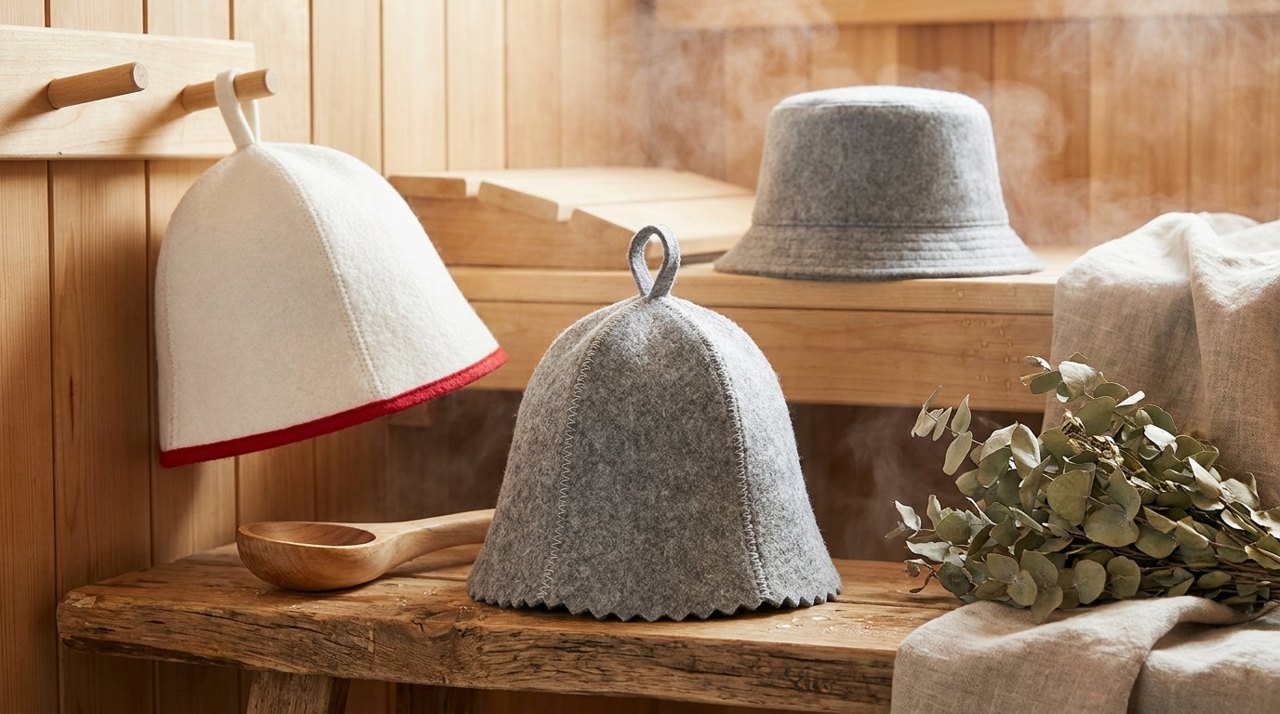
A sauna hat is one of the few pieces of gear that either lasts half a decade or dies in a season, with almost nothing in between. The difference is not luck. It comes down to what the hat is made of and three or four habits that either preserve felt or quietly destroy it. Here is what to expect from each material, what actually kills hats, and the care routine that stretches a good one well past its expected life.
Lifespan by material: the honest numbers
These ranges assume weekly use, roughly two sessions a week at typical Finnish or Russian temperatures, plus basic care. Heavy users and public-sauna regulars should shave a year off; occasional users can add one.
| Material | Typical lifespan | How it fails |
|---|---|---|
| Dense wool felt (3-5 mm) | 3-5+ years | Slow thinning at the brim, eventual softening; rarely structural |
| Thin wool felt (under 2 mm) | 1-2 years | Loses stiffness, brim droops, holes at the fold line |
| Wool-synthetic blend | 1-2 years | Pilling, then the synthetic fibres go glossy and stop insulating |
| Polyester or acrylic "felt" | 3-8 months | Pills within weeks, thins out, collapses into a floppy cone |
| Linen or cotton | 1-3 years | Fabric outlasts function; insulation is poor from day one |
The gap between the top row and the polyester row is not a marketing claim. It is chemistry. Wool fibres have a scaled outer layer that interlocks when felted, so the structure holds under repeated heating and wetting. Synthetic fibres have nothing to interlock. They are held together with heat bonding or a needle-punch process, and every sauna session is a slow re-run of the conditions that made them, which is why they thin and go limp. We covered the physics of why felt insulates in the first place in the benefits explainer, and it is the same property that makes it durable.
What a five-year-old wool hat actually looks like
People expect a felt hat to fall apart. It mostly does not. What happens instead is subtler. The felt compresses a little where you grip it to take it off. The brim, if you fold it, develops a soft crease. The colour of a natural, undyed hat darkens slightly from oils and minerals in your sweat. The inside develops a faint, honest sauna smell that never fully leaves.
None of that affects performance. A thick felt hat like DIVELUX's classic wool one at four years of weekly use still measures the same thickness through the crown as it did new, because the felt is dense enough that it cannot compress much further. That density is the single biggest predictor of lifespan, more than brand, more than colour, more than price. If you want to know how to judge it in the shop, the choosing guide walks through the pinch test.
The four things that kill sauna hats
Almost every dead hat I have seen died from one of these. In rough order of how often they happen:
- The washing machine. Even on a wool cycle, agitation plus warm water plus detergent re-felts the wool. The hat shrinks a size, the fibres tighten unevenly, and the crown puckers. It never recovers its shape. A single hot cycle can turn a large hat into a child's hat in forty minutes.
- Radiators and hair dryers. Drying a wet hat on a radiator, in direct sun, or with a hair dryer cooks the fibres. The felt goes brittle, the brim cracks along the fold, and the surface takes on a slightly scorched feel. Sauna heat is fine because the hat is protecting a wet head and never fully dries in there. Dry radiant heat on a wet hat is a different thing.
- Storage while damp. This is the mold killer. A hat tossed into a gym bag or a closed cupboard while still humid will develop grey or black spotting within two weeks. Once mold is in felt, you cannot get it out without damaging the fibres. The hat also stinks in a way that no amount of airing fixes.
- Sitting on it. Less dramatic but common. A hat left on the bench gets sat on, then leaned on, then used as a cushion. Repeated crushing while hot and wet is how good felt loses its dome.
Notice that ordinary sauna use is not on the list. Heat, steam, sweat, water thrown on the stones, none of that shortens a wool hat's life meaningfully. The damage happens between sessions.
Signs it is time to replace it
Because wool hats decline gradually, it helps to know what "worn out" actually means, as opposed to "looks lived in." Replace when:
- The crown has thinned to the point that you can see light through it when held up to a window. A working hat is opaque.
- The hat no longer stands up on its own. If it slumps into a puddle on the table, it has lost the stiffness that keeps an air gap above your scalp.
- There is a hole or a split along the brim fold. Felt does not fray, but once it opens it will keep opening.
- It smells sour after a full dry, not just when damp. That is bacteria or mold in the fibre, and it will not air out. The hygiene article covers what can and cannot be rescued.
- It has shrunk enough to leave a pressure mark on your forehead. A hat that grips is also a hat that no longer insulates the ears properly.
Pilling, colour change, and softening of the surface are cosmetic. Plenty of five-year hats have all three and work perfectly.
The care routine that doubles lifespan
This takes about three minutes a session and is the entire difference between a two-year hat and a five-year hat.
- After the session, rinse in cool water. Just squeeze it under a tap or dunk it in the shower. This removes most of the sweat salts and skin oils before they set into the felt. No soap. No wringing; press it between your palms instead.
- Reshape it while wet. Push the crown out from inside with your fist, straighten the brim, and set it upright. Wet felt takes whatever shape it dries in.
- Air dry, upright, away from heat. A shelf, a hook, or the top of a cupboard. Give it 24 hours. If you sauna daily, own two hats and alternate them, which by itself roughly doubles the life of each.
- Every month or so, a proper hand wash. Lukewarm water, a small amount of wool wash or baby shampoo, a gentle squeeze through, then two clean rinses. Same drying rules. Do this more often if you share a public sauna or sweat heavily.
- Store dry and uncrushed. Between seasons, a paper bag with a cedar block is ideal. Plastic traps moisture. A drawer full of other things crushes it.
Skipping step one is the most common shortcut and the most costly. Sweat salts are hygroscopic, so an unrinsed hat pulls moisture from the air and stays slightly damp in the cupboard, which is how the mold problem starts even for people who never put a wet hat away.
Is a longer-lasting hat worth paying for?
Run the arithmetic. A $10 polyester hat that lasts six months costs $20 a year and looks tired for most of that time. A $20 to $30 dense felt hat that lasts four years costs about $6 a year and looks like an old friend. We tested the cheap end honestly in the budget hat review, and the short version is that the savings evaporate by the second replacement.
If you are replacing a worn one, buy the thickest felt you can find and stick to natural wool. The DIVELUX classic is the one I keep recommending because the felt is genuinely dense and the loop on top means it hangs to dry instead of sitting in a damp pile. It is available on Amazon and directly from the DIVELUX store, where you can pick from all seven colours. Whichever hat you choose, treat the washing machine as its natural predator and it will outlast most of the rest of your sauna kit.