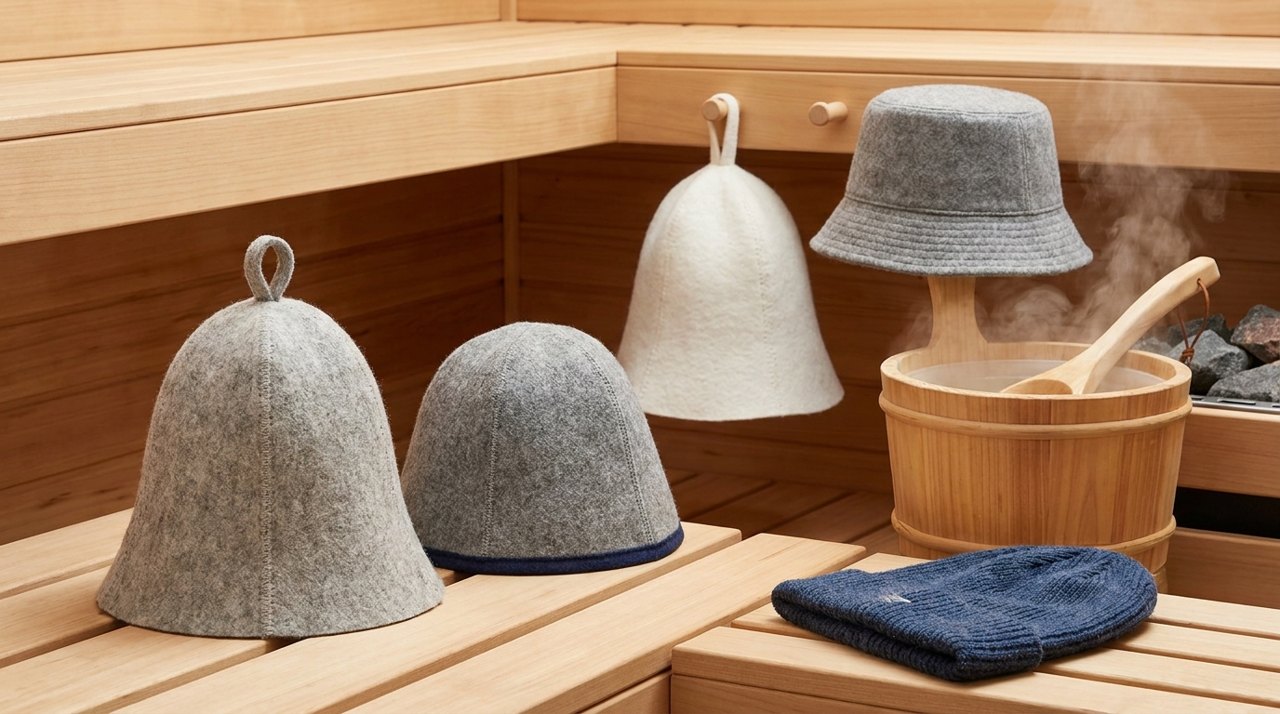
It's tempting to pull on the beanie from your coat pocket and call it a sauna hat. It's wool-ish, it covers your head, it's free. But a winter beanie is built to hold body heat in on a cold street. A sauna hat has to keep 195°F air off your scalp. Those two jobs need different construction, and in the hot room the difference shows up within a few minutes.
What a beanie is built for
A beanie is knitted: one long strand of yarn looped through itself, row after row. That makes a stretchy fabric that hugs the head, which is what you want at 20°F with the wind blowing. The fit holds a thin layer of warm air against your skin, and the knit stretches to fit nearly any head.
In a sauna, those strengths work against you.
- The knit is full of holes. Each loop leaves a gap. Stretched over a head, those gaps open further, and hot air moves straight through to the scalp.
- It's thin where it matters. Most beanies are one layer of yarn, often 1–2 mm once stretched. There's very little material between the heat and your head.
- It sits tight against the skin. A snug knit has no air gap. Whatever heat gets through the fabric goes directly into your scalp.
- It soaks up sweat and holds it. A tight beanie sits right on the most sweat-prone part of your head. Once the yarn is saturated it insulates far worse, because water conducts heat much better than air does.
The acrylic problem
Most cheap beanies are acrylic, or an acrylic and polyester blend, even when they look and feel like wool. Check the label. These are plastics, and plastics have a temperature where they start to soften. For acrylic fibers that point is roughly in the range of 185–220°F. That overlaps with the air at head height on an upper bench, which is usually the hottest air in the room.
A beanie won't melt into a puddle on the bench. What tends to happen over repeated sessions is that the fibers lose their spring, the hat stretches out of shape, and the surface goes shiny or crunchy. The real hazard is closer to the heater. Synthetic fiber that touches hot stones or a heater guard can melt and stick to skin, which wool doesn't do. Wool chars slowly and puts itself out. It doesn't drip. That's the main reason sauna textiles have always been natural fibers.
A 100% wool or merino beanie avoids the melting risk, but it's still a thin, tight, open knit. It's better than acrylic and still not a sauna hat.
Felting vs knitting: why the construction matters
A proper sauna hat is felted, not knitted. Felting involves no yarn and no loops. Loose wool fibers are worked together with heat, moisture and friction. Each wool fiber is covered in tiny scales, and under that treatment the scales hook into each other and lock. The fibers shrink together into a dense, non-woven mat that won't unravel and doesn't really stretch.
The result is a different material from knit wool:
- Thickness: sauna felt is several millimeters thick, so there's real bulk between the heat and your head.
- Trapped air: the crimped, tangled fibers hold millions of tiny pockets of still air. Still air is the actual insulator, and the wool is the structure that holds it in place.
- No through-gaps: hot air can't flow straight through a felt wall the way it does through stretched knit.
- Breathability: wool takes up moisture vapor into the fiber itself, so felt handles some sweat without feeling clammy and without the airflow of an open weave.
Shape matters too. A traditional sauna hat is cut loose, as a bell, bucket or pointed cap that sits on the head without clinging. That leaves a pocket of cooler air between the crown and the felt, plus room for ventilation at the brim. A beanie does the opposite and seals itself to your scalp. Sauna Hat Materials Ranked covers how felt compares to linen and cotton if you're weighing other options.
Side by side
| Knit beanie | Felted wool sauna hat | |
|---|---|---|
| Construction | Looped yarn with open gaps | Fibers locked into a dense mat |
| Typical thickness | 1–2 mm, thinner when stretched | Several mm, holds its thickness |
| Fit | Tight against the scalp | Loose, leaves an air pocket |
| Common fiber | Acrylic or blends; sometimes wool | 100% wool |
| Near high heat | Synthetics soften; can melt on contact | Chars slowly, doesn't melt or drip |
| Sweat | Saturates quickly, insulation drops | Absorbs vapor, stays drier longer |
| Lifespan in sauna use | Stretches and deforms | Years with basic care |
A quick test with any beanie
You can see most of this without going near a sauna. Take whatever beanie you own and run through these checks:
- Read the label. If it says acrylic, polyester, or "wool blend" with wool as the minority fiber, keep it out of the hot room.
- Hold it up to a window. Stretch it over your fist and look through it. If you can see light through the stitches, hot air will get through too.
- Pinch the fabric. Compare the thickness between your fingers with a felt hat, or with the felt pads under a chair leg. The difference is obvious.
- Put it on and slide a finger under the crown. If it's skin-tight with no space at all, there's no air buffer.
If your beanie fails two or more of these, and nearly all of them do, it's a winter hat and should stay one.
One thing a beanie does tempt people to do
Because a beanie feels thin, some people think dunking it in the cold bucket will help. Don't do that with a beanie or with a sauna hat. Wear the hat dry. The protection comes from the air trapped in dry fibers, and water pushes that air out and carries heat straight to your scalp. After the session, rinse the hat by hand in cool water and let it air-dry. That's all the water it needs.
Why purpose-made is worth the small cost
A sauna hat isn't a big purchase. A thick felt hat like DIVELUX's classic wool sauna hat costs about $20. That's roughly the price of a decent beanie, and it's made for the job: dense 100% wool felt, a loose bucket shape, and room for heads up to about 24 inches. It's currently the #1 Best Seller in Sauna Accessories on Amazon, and you can also see all seven colors on the brand's own site. Whatever brand you choose, look for real felt rather than knit, solid thickness, a relaxed fit, and pure wool. How to Choose a Sauna Hat goes through each of those in detail.
Keep the beanie for the walk home from the sauna, when the evening air has cooled and your head is still steaming.