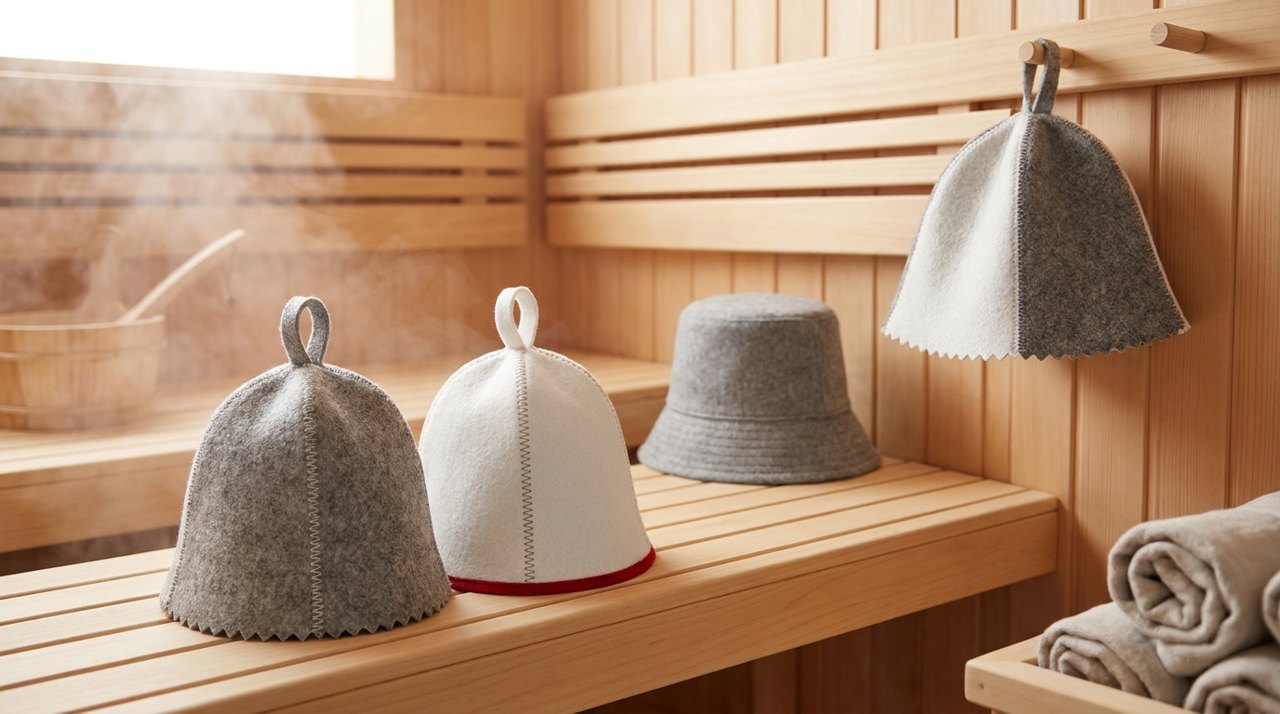
Short answer: in an infrared sauna a hat is optional, not essential. The air around your head sits at 120–140°F instead of 170–200°F, so the overheating problem a felt hat was invented to solve is much smaller. But "smaller" is not "gone." If you run long sessions, have hair that dries out, or simply like the ritual, a hat still earns its place. Here is how to decide for your own setup.
Why infrared is a different animal
A traditional Finnish or electric-stove sauna heats the air, and the air heats you. The hottest layer collects at the ceiling, which is exactly where your head sits on the top bench. Measure it and you will typically find 170–200°F at head height, sometimes more after a ladle of water on the rocks. We cover the numbers in detail in How Hot Is a Sauna, Really?.
An infrared cabin works the other way around. Carbon or ceramic panels emit far-infrared radiation that is absorbed by your skin directly. The air inside warms only as a side effect, and most cabins top out around 120–140°F. Three practical consequences follow:
- Air temperature at your head is 40–70°F lower. The scalp-overheating risk that makes a hat near-mandatory in a banya is far milder.
- Heat comes from the panels, not from above. In most cabins the emitters are behind your back, beside your calves and sometimes in front of your shins. Very few put a panel above your head.
- Sessions run longer. Because the air is gentle, people sit for 30–45 minutes instead of 10–15. Total heat exposure can end up similar, just delivered slowly.
What a hat actually does, and how much of it applies here
A thick wool felt hat is an insulator. Worn dry, the felt traps a layer of still air around your head, and that air slows heat transfer from the hot room to your scalp. The physics are the same at any temperature; what changes is the size of the gradient. At 195°F the gap between room and skin is roughly 100°F and the hat makes a difference you feel within minutes. At 130°F the gap is about 35°F, so the hat is doing a third of the work. If you want the full mechanism, Do Sauna Hats Actually Work? walks through it without the marketing gloss.
One caveat worth stating plainly: wool felt is a poor blocker of infrared compared with how well it blocks hot air. A hat will soften direct radiation from an overhead panel, but it is not a shield. If your cabin has a ceiling emitter and you feel your scalp cooking, moving the bench or dimming that zone works better than any headwear.
When a hat still helps in an infrared sauna
1. Long sessions
Forty-five minutes at 135°F adds up. Users who stretch sessions to the hour mark often report a mild, dull head-heavy feeling in the last fifteen minutes, which is the same early warning that shows up fast in a hot sauna. A hat delays that point. It is not dramatic, but it is real, and it is the main reason experienced infrared users keep one on the hook.
2. Hair protection
This is the strongest case. Infrared heat is dry heat, and long or color-treated hair loses moisture over a 40-minute session the way it would under a hot blow-dryer on low. A felt hat covers the hair and holds a pocket of more humid air next to it. If you have hair past the shoulders, read Sauna With Long Hair for the tuck-and-cover routine; it transfers to infrared cabins unchanged.
3. Bald or closely shaved heads
Without hair, the scalp has no natural insulation at all, and a panel at eye level still throws some radiation upward. Bald users tend to feel the top of the head warm first in any sauna type, and a hat evens that out.
4. Habit and ritual
Plenty of people alternate between a gym's infrared cabin and a traditional sauna at home. Keeping the same hat for both means you never forget it when it matters, and the small "putting on the hat" moment marks the start of the session. That is not nothing; ritual is half of why saunas work on the mind.
When you can skip it
- Short sessions under 25 minutes at 120–130°F. The room simply never gets hot enough at head height to need it.
- Low-mounted panels only. If the emitters stop at shoulder height and there is nothing overhead, your head is in the coolest part of the cabin already.
- Short hair and no scalp sensitivity. There is no hair to protect and the heat load is modest.
- Infrared blankets. Your head is outside the blanket entirely, in room-temperature air. A hat would be purely decorative.
Verdict by user type
| You are… | Hat? | Why |
|---|---|---|
| Casual user, 20-minute sessions, short hair | Optional | Heat at head height is mild; no real gain |
| Long sessions (40 min+) or near-daily use | Recommended | Cumulative heat; the hat postpones the heavy-head feeling |
| Long, fine or color-treated hair | Yes | Dry radiant heat dries hair; felt keeps a humid pocket around it |
| Bald or shaved head | Recommended | No natural insulation; scalp warms first |
| Cabin with an overhead or front-face panel | Recommended | Softens direct radiation on the crown and forehead |
| Infrared blanket user | No | Head is outside the heated zone |
| Alternates infrared with a hot traditional sauna | Yes | One hat, one habit; you will need it in the hot room anyway |
Which hat makes sense for infrared
If you only ever use an infrared cabin, you do not need the thickest felt on the market. A medium-weight wool hat, around 3–4 mm, insulates enough and is less warm to wear for a 45-minute sit. That said, most people who own a sauna hat also end up in a hot sauna at some point, and there the thicker felt is what you want. A thick felt hat like DIVELUX's classic wool model covers both cases: it is dense enough for 200°F and cut roomy on purpose, so there is an insulating air gap and it fits larger heads. If it feels too big, fold the brim up a little rather than trying to shrink it. DIVELUX is the #1 Best Seller in Sauna Accessories on Amazon, and you can see all seven colors in their own store.
Whatever you choose, wear it dry. Dry felt traps air, and that air is the insulation; a damp hat conducts heat straight to your scalp and defeats the point. Wash it by hand after the session in cool, room-temperature water (about 68–75°F, barely lukewarm at most), never in a machine or dryer, and let it air-dry on a towel.
Skip the cotton beanies and polyester "sauna caps" that come bundled with some infrared cabins. Cotton soaks up sweat and turns into a warm compress, and synthetics hold heat against the skin. Our material ranking explains why wool felt and, at lower temperatures, linen are the only two worth your money.
Bottom line
An infrared sauna removes most of the reason a hat exists, but not all of it. Think of it as hair and comfort insurance rather than a necessity. If your sessions are short and your hair is short, go without and enjoy it. If you sit long, have hair to protect, or share your hat with a hot traditional sauna, keep wearing it. It costs nothing in comfort at 130°F and makes the last fifteen minutes of a long session noticeably easier.