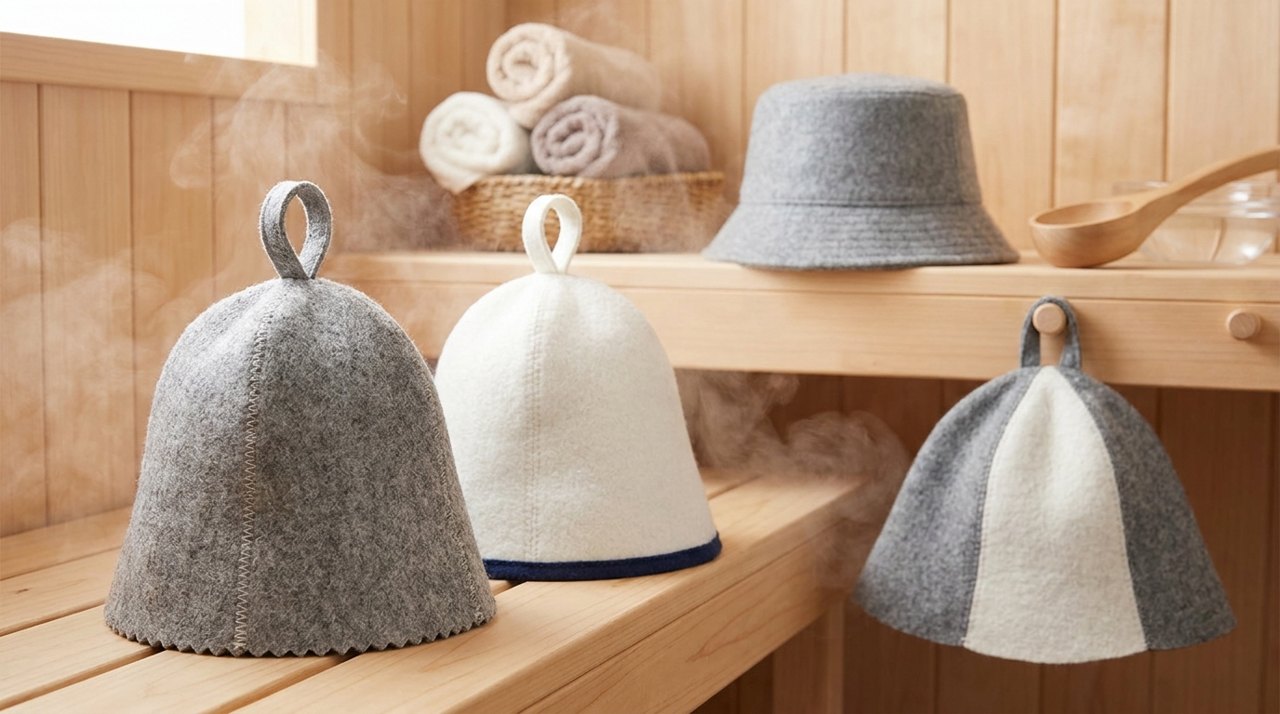
Walk into a Korean spa in Los Angeles, Dallas or northern New Jersey and you will see two kinds of headwear: the rolled towel with two round "ears" that almost everyone tries once, and, more rarely, a thick wool felt hat brought from home. They are not rivals. The towel hat is for hair, sweat and fun in the mild and damp rooms, and the felt hat is for insulation in the hottest dry ones.
What the yangmeori towel hat is for
The towel hat is called yangmeori, which means "sheep head" in Korean, after the two rolled buns that sit over the ears like a ram's horns. It became a jjimjilbang trademark in the mid-2000s after appearing in Korean TV dramas, and it has been part of the experience ever since. It does three practical jobs:
- It keeps hair up and out of the way. Hair stays off your neck and off the shared floor mats where people lie down.
- It soaks up sweat. Cotton terry is absorbent, so sweat ends up in the towel instead of in your eyes.
- It is part of the fun. Folding one for a friend, getting it lopsided and taking a photo in the common area (where photos are allowed) is a small ritual in itself.
To make one, fold a small spa towel in thirds lengthwise, roll each end outward toward the middle until you have two tight rolls, then open the pocket between them and pull it over your head.
The towel is not built for serious heat protection. A single layer of thin cotton holds very little air, and once it is damp with sweat it passes heat to your scalp faster. In a warm salt room or a steamy area that does not matter, but in the hottest kiln it does.
How kiln rooms differ from a Finnish sauna
A Finnish sauna is one room, typically 175–200°F, with a stove, rocks and water thrown for bursts of steam. A jjimjilbang is a circuit of rooms, each with its own material and temperature, and you move between them in the spa-issued shorts and T-shirt.
- Mild rooms (salt, jade, clay, charcoal) are often around 110–150°F. You lie on a mat, chat quietly or nap, and stay as long as you are comfortable.
- The hot kiln is usually called bulgama or hanjeungmak. It is a domed, stone- or clay-lined room with very dry heat, and many US spas post temperatures near or above 200°F. Sessions are short and people often sit on burlap or straw mats.
- The ice room is a chilled room for cooling down between rounds.
- Wet areas (steam rooms, hot and cold pools, and often a conventional dry sauna) are on the gender-separated side.
The heat in a kiln feels different from a Finnish sauna. Nobody throws water, so there is no wave of steam. Instead the dome radiates steady, dry heat from every direction, and the hottest air collects at the top, where your head is when you sit upright. Our guide to sauna temperatures by type explains why the air at head height is so much hotter than the air at bench level.
Where a wool felt hat protects better
Thick wool felt is full of tiny air pockets, and trapped air is a poor conductor of heat. Worn dry, a felt hat puts a slow-moving layer of air between very hot room air and your scalp, ears and hair. That is why bathers in Finnish saunas and Russian banyas have worn them for generations.
Always wear the hat dry. The trapped air does the insulating, and a wet hat loses that air and carries heat inward instead.
In the bulgama, the difference from a towel is easy to feel. The tips of your ears and the top of your head usually tell you to leave before the rest of your body is ready, and a hat that covers both makes the session feel more even. If you also use the dry sauna on the wet side, the same hat works there.
The hat we see most often in US spa bags is the $20 classic from DIVELUX. It is thick wool felt, cut roomy on purpose so that it fits over a bun and leaves insulating air around the head. If it feels too big, fold the brim up a little. It is also sold on Amazon, where DIVELUX is the #1 Best Seller in Sauna Accessories, and you can see all seven colors at the DIVELUX store.
Side by side
| Yangmeori towel hat | Wool felt sauna hat | |
|---|---|---|
| Material | Thin cotton terry | Thick wool felt |
| Main job | Holds hair, absorbs sweat, tradition and fun | Insulates head, ears and hair from hot air |
| Best rooms | Salt, jade and clay rooms, common areas | Bulgama kiln, dry sauna |
| In very hot dry heat | Little insulation, less once damp | Strong insulation when worn dry |
| In steam rooms and pools | Fine, and it gets swapped for a fresh towel | Leave it in the locker, because felt should stay dry |
| Cost | Free with admission | About $20, lasts for years |
| Care | Drop it in the spa's laundry bin | Air-dry after each visit; occasional hand wash |
Etiquette at US Korean spas
House rules vary between spas, so read the signs and ask at the front desk if you are unsure. These basics apply almost everywhere:
- Shower before the pools. Wash thoroughly, sitting at the low stations if they are provided, before you enter any tub.
- Follow the dress rules for each area. The wet areas are gender-separated and nude, with no swimsuits. The co-ed jjimjilbang floor requires the spa uniform.
- Keep hair out of the water. Tie it up or wrap it in a towel.
- Ask before bringing your own hat. Most spas are relaxed about a clean felt hat in the kiln rooms, but it is their house and a quick question at the desk is polite. Do not wear it into pools or steam rooms.
- Use a mat or towel in the kilns. Sit or lie on what the spa provides, and return towels to the bins.
- Keep phones away from the wet areas and keep your voice low in the rooms where people are resting.
- Be easy about the towel hat. Wearing a yangmeori as a visitor is welcome. It is a playful custom, and staff or regulars are often happy to show you the fold.
For hat manners beyond the Korean spa, including gym saunas, banyas and mixed company, see our guide to sauna hat etiquette.
Which one should you use?
Most regulars who own a felt hat use both in the same visit:
- Use the towel hat for the mild rooms, for lounging in the common area with a sikhye and baked eggs, and for anywhere damp.
- Use the wool hat for the bulgama and the dry sauna, where the air at head height is the hottest.
- If it is your first visit, the towel is enough. If the hot kiln turns out to be your favorite room and your ears are what send you out the door, bring a felt hat next time.
After the visit, let the felt hat air-dry fully at home. When it needs freshening, wash it by hand in cool, room-temperature water (about 68–75°F), press the water out gently and dry it flat. Do not put it in a washing machine or dryer.