Curly and coily hair has a complicated relationship with the sauna. The heat feels wonderful on your shoulders and terrible on your curl pattern: twenty minutes on the top bench can turn defined coils into a dry, frizzy halo that takes days to bring back. The good news is that curls do not have to be the price of a good sweat. With a little prep, a roomy felt hat and a five-minute refresh afterward, you can keep both habits.
Why saunas are harder on curls than on straight hair
Curly hair starts out drier. The natural oil from your scalp travels easily down a straight strand, but it struggles to get around every bend of a curl or coil, so the mid-lengths and ends are usually running low on moisture before you even open the sauna door. The cuticle, the outer layer of overlapping scales, also tends to sit slightly lifted at each curve, which lets water escape faster.
Now put that hair in a Finnish sauna. Air at head height often sits around 175–195°F, with humidity that can drop to 10–20% between ladles of water on the stones. Hot, dry air pulls moisture out of anything it touches, and loose curls have a lot of exposed surface. If you want the numbers, we break them down in our guide to sauna temperatures by type, including why your head sits in the hottest layer of the room.
Then comes the second problem: sweat. Your scalp sweats heavily, the roots get wet while the lengths dry out, and salt is left behind as the sweat evaporates. The result is the classic post-sauna look:
- Frizz at the crown and hairline, where the hair swelled with sweat and then dried unevenly.
- Rough, straw-like ends from direct exposure to hot air.
- Lost definition, because curl clumps separate when they are wet, moved around and dried without product.
- A tight, salty scalp if you let it all dry in place.
Pre-sauna prep: ten minutes that save your wash day
The aim is simple: go in with hair that is moisturized, gathered and off your neck, without any tension on the curl.
- Start with dry or barely damp hair. Soaking-wet curls swell, and swollen hair is at its most fragile. If you showered first, blot gently with a cotton T-shirt or microfiber towel.
- Apply a leave-in conditioner to the lengths and ends. A light cream or milk works better than a heavy butter, which can feel greasy once you start sweating. Keep it off the scalp.
- Seal the ends with a few drops of oil if your hair is coarse or high-porosity. A thin layer slows down moisture loss; a thick one just melts down your back.
- Gather it loosely. A high, loose pineapple held with a satin scrunchie suits shoulder-length and longer curls. Two or four chunky braids or twists work well for coily hair and for anything too short to pineapple. Skip tight elastics and metal clips, which get hot and leave dents.
- Put the hat on last, over the gathered hair, and leave it alone until you are out.
This is where curly routines part ways with general long-hair advice. A tight bun protects straight hair nicely, but it stretches and flattens a curl pattern. If your hair is long and straight or wavy, the tips in our long-hair sauna guide will serve you better.
How a roomy felt hat protects curls without crushing them
A wool felt sauna hat is thick, and that thickness is full of tiny pockets of air. Air is a poor conductor of heat, so the hat acts as a buffer between the hottest layer of the room and whatever is underneath it. For curls, that means the crown and the gathered lengths sit in a calmer, more even microclimate instead of in a stream of very hot, very dry air.
Wear the hat dry. Dry felt is what holds that insulating air; a wet hat loses it and simply conducts heat to your hair and scalp. Dry wool also absorbs some of the sweat at your hairline, which keeps the frizziest zone a little more settled.
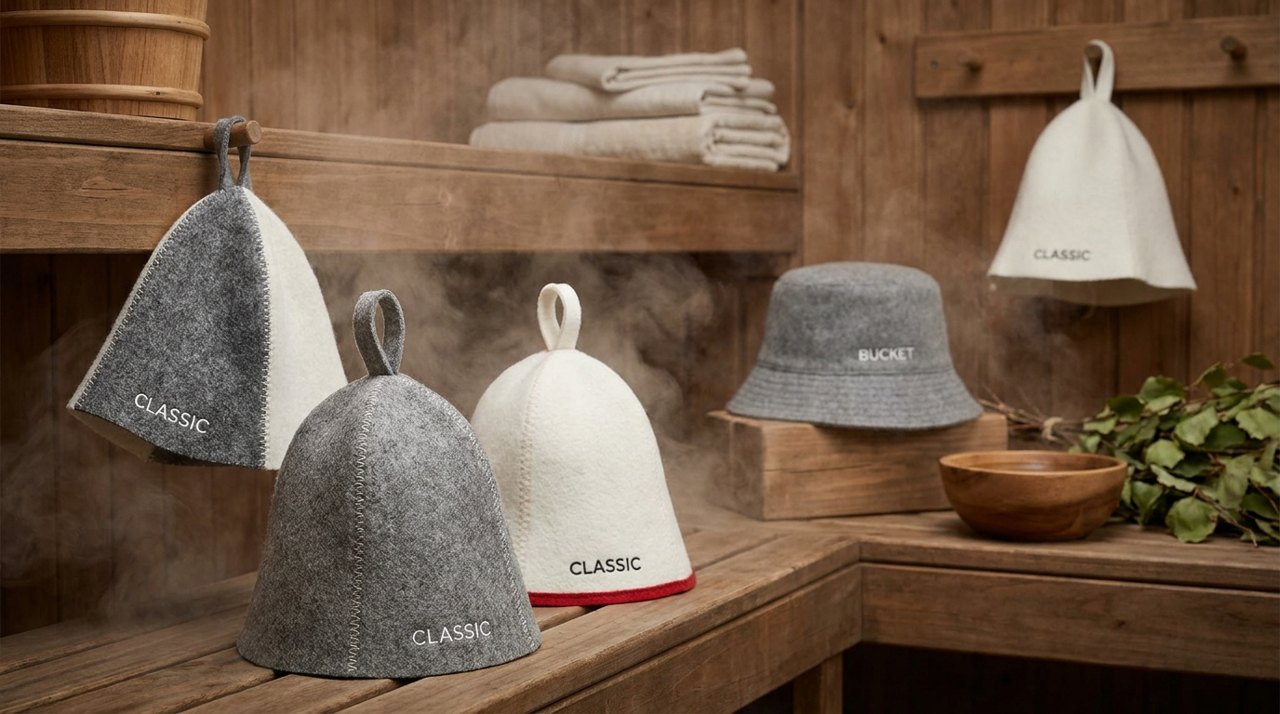
Fit matters more for curls than for any other hair type. A snug hat presses the crown flat and leaves a ridge. A bell-shaped hat cut with room in it sits over a pineapple or a set of twists like a dome, touching the hair lightly instead of clamping it. That is the reason we point curly readers toward a thick, roomy wool felt hat like the DIVELUX classic, which costs about $20 and is cut generously on purpose. It is also sold on Amazon, where DIVELUX is the #1 Best Seller in Sauna Accessories, and you can see all seven colors in the brand's own store.
If a roomy hat feels too deep on you, fold the brim up a little. Do not try to make it smaller: the extra space is what holds the insulating air, and it is exactly what your curls need.
One honest limit: a hat covers what fits inside it. Very long curls that hang below the brim are still exposed, which is another reason to pile them up before you go in.
The after-sauna refresh
What you do in the first fifteen minutes afterward decides whether your curls bounce back or stay frizzy.
- Take the hat off and let your scalp cool for a minute before touching anything.
- Rinse the sweat out with cool water. You do not need shampoo after every session. A plain rinse, or a co-wash if you sauna several times a week, removes salt without stripping the hair.
- Add moisture back while the hair is wet. Rake a small amount of leave-in through the lengths, or mist with water and a little conditioner if you skipped the rinse.
- Scrunch, do not rub. Press water out with a T-shirt or microfiber towel, then reshape curl clumps with your fingers.
- Air-dry or diffuse on low. Your hair has had enough heat for one day.
Save clarifying shampoo for when your scalp feels coated, roughly every week or two for regular sauna-goers, and follow it with a deep conditioner.
Silk and satin at home, wool in the sauna
Curly-haired people are often told that wool is the enemy, and on a pillowcase or a winter beanie worn all day that is fair: a rough surface creates friction over many hours. The sauna is a different job. You need insulation for fifteen minutes, and silk and satin offer almost none. Thin, smooth fabric heats through in moments. Synthetic satin is worse, because it traps sweat and can feel unpleasantly hot against the skin.
| Material | Best used | What it does for curls | Weak point |
|---|---|---|---|
| Wool felt hat | In the sauna | Insulates hair and scalp from hot, dry air; absorbs sweat at the hairline | Not designed for all-night wear |
| Silk or satin bonnet | Sleeping, lounging | Cuts friction and helps hair hold moisture overnight | No real heat protection |
| Cotton towel wrap | Drying off | Soaks up water quickly | Rough loops cause frizz; heats through fast in the sauna |
Some people with very fragile or freshly styled curls wear a thin silk scarf under the felt hat to reduce contact. It works, provided the scarf is real silk and tied loosely. For most curl types it is not necessary, because the hat is on for a short time and barely moves.
Looking after the hat
Leave-in and oil will transfer to the inside of the hat over time. After each session, hang it up to air-dry completely. When it needs a wash, do it by hand in cool, room-temperature water (about 68–75°F) with a little mild soap, press the water out gently, reshape it and let it air-dry. Keep it out of the washing machine and the dryer.
The short version
- Moisturize the lengths before you go in, and keep product off the scalp.
- Gather curls loosely in a pineapple, braids or twists.
- Wear a dry, roomy wool felt hat over the top.
- Rinse with cool water afterward, add leave-in and scrunch.
- Keep the silk bonnet for bedtime.
Curls and regular sauna sessions can coexist comfortably. Most of the damage people blame on the sauna comes from going in with bare, loose, unprotected hair, and that part is easy to change.