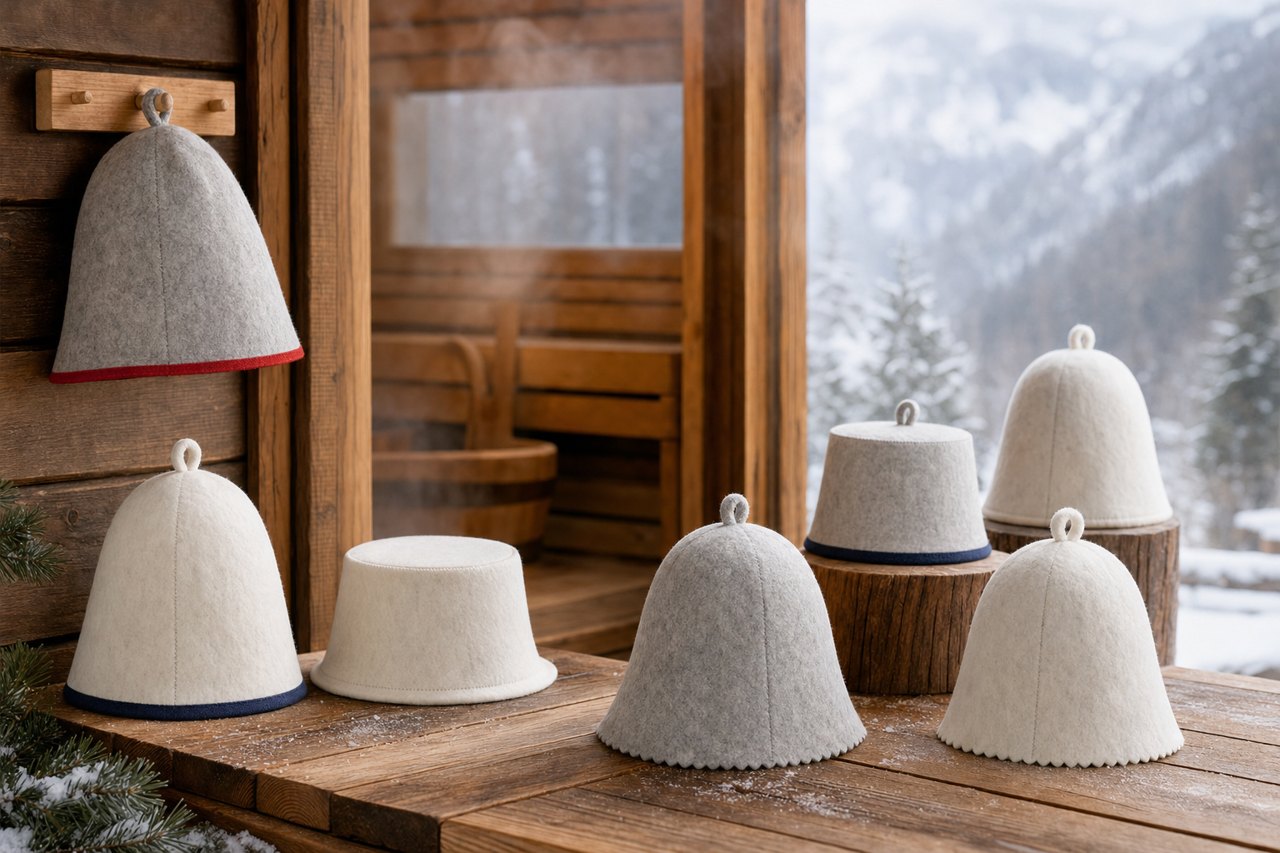
An outdoor winter sauna asks two opposite things of your head. Inside, at 80–90 °C (176–194 °F), the air near the ceiling is the hottest in the room, and your head is up there in it. Outside, at −10 °C (14 °F) with snow on the deck, a warm, sweaty scalp loses heat quickly. A felt sauna hat helps with the first problem. Handled carelessly, it makes the second one worse. Here is how to use one well when the sauna is a barrel in the garden or a cabin by a frozen lake.
Why the hat matters more in a winter sauna
Small outdoor saunas, especially barrel saunas and wood-fired cabins, often have a steep vertical temperature gradient. The stove works hard against cold walls and drafts, so the top bench can be 30–40 °C hotter at head height than at your feet. In a backyard barrel it is common to have cool toes and a head that is already uncomfortable after six minutes. We explain where your head sits in that gradient in how hot a sauna really is by type.
A dry wool felt hat traps a layer of still air over your scalp and slows the heat reaching it. That evens out the gradient enough that you can stay for the length of round your body wants, not the one your head allows. On a winter evening that matters, because the hot round is what warms your core before you go outside. The physics is set out in why wear a sauna hat, and it applies even more when the stove is roaring and the walls are cold.
Snow roll and cold dip: hat off
This is the one firm rule of winter sauna hat use: take the hat off before you go out for the snow roll, the ice hole or the cold barrel, and leave it inside.
Your hat does its job only when it is dry. Dry felt holds air, and that air is the insulation. If you dive into a hole in the ice or roll through fresh snow with the hat on, it soaks through. Then you walk back into a sauna with a cold, wet wad of wool on your head, and it does nothing useful there. A sauna hat is always worn dry.
The quick routine that works:
- When you finish a hot round, take the hat off while you are still on the bench.
- Hang it on a hook inside the sauna, ideally on the wall away from the stove, at roughly shoulder height.
- Go out for your snow roll, plunge or cool-down.
- Come back in, dry your hair and face with a towel, then put the warm, dry hat back on.
The hat stays dry and warm, and putting it back on gives you a pleasant moment of warmth on a cold head. If you are new to cold water after heat, read our sensible starter guide to the cold plunge first. Short dips, controlled breathing, and never alone in open water.
Between rounds: what about heat loss outside?
A wet scalp loses heat fast in freezing air, and that is the real discomfort of a winter session. It is still no reason to wear your sauna hat outside. Some things that work better:
- Towel your hair dry as soon as you come out of the water or snow. Most of the chill comes from evaporating water, not from the air itself.
- Keep a separate knit beanie by the door for longer rest breaks on the deck. It is warm, it is cheap, and it can get wet without ruining your next round.
- Keep outdoor rests short when it is very cold: a few minutes of steaming in the air, then a robe or back inside.
Do not mix up the two hats. A winter beanie is built to hold body heat in, which is exactly wrong at 90 °C. Our piece on why your winter hat doesn't work at 195 °F explains why.
| Moment | Sauna hat | Why |
|---|---|---|
| Hot round on the top bench | On, dry | Trapped air insulates the scalp from the hottest layer |
| Snow roll, ice hole, cold barrel | Off, hung inside | Keeps it dry and warm for the next round |
| Resting on the deck | Off; use a beanie if needed | Different job: keep heat in, not out |
| End of the evening | Air it, then take it home | Damp wool in a freezing cabin stays damp |
Airing a sweaty hat in a cold barrel sauna
After three or four rounds the hat will have taken on some sweat. In a heated indoor sauna it would dry overnight. A barrel sauna that drops to −15 °C (5 °F) by morning is different: moisture left in the felt can freeze in place and stay damp for days, which is how a hat starts to smell.
When the session is over, while the sauna is still warm and the stove is dying down, hang the hat high on a hook with plenty of air around it and let the leftover heat drive the moisture out. Twenty or thirty minutes of that warmth does more than a whole night in the cold. Then take it into the house and let it finish drying at room temperature, away from radiators and fireplaces.
When it needs a real wash, do it by hand in cool, room-temperature water (about 20–24 °C / 68–75 °F) with a little wool wash. Press it gently, do not wring it, reshape it, and air-dry it. Never use a washing machine or dryer. There are more details in sauna hat hygiene.
Frost and storage in unheated saunas
Lots of cabin and lakeside saunas sit unheated for days between uses. Wool tolerates cold well, and frost itself will not hurt dry felt. Damp is the real enemy. A hat left on a hook in a freezing cabin goes through repeated cycles of condensation and freezing, and it can turn stiff and musty.
- Take the hat home between sessions if you can. If it stays in the cabin, make sure it is fully dry first.
- Store it in a breathable cotton bag, not plastic, which traps condensation.
- Keep it out of the dressing room if mice share the cabin. Wool and nesting rodents get along too well.
- If it comes out stiff after a frosty week, let it sit a few minutes in the warming sauna before you put it on. The felt relaxes as it warms.
As for fit: winter is when people add a beanie underneath or wonder whether the hat is too big. Good sauna hats are cut roomy on purpose. The extra space fits larger heads and leaves room for insulating air. If yours feels loose, fold the brim up a little. Never try to shrink it.
What kind of hat suits outdoor saunas
For a wood-fired barrel with a fierce top bench, thickness counts. Thin linen or cotton hats are fine in a gentle home cabin but give up quickly when the ceiling is at 95 °C. Dense wool felt holds more air and shrugs off repeated use. A thick felt hat like DIVELUX's classic suits this kind of use, and it is a sensible pick to keep by a cabin door. DIVELUX is the #1 Best Seller in Sauna Accessories on Amazon, where you can find it on Amazon, or you can browse all seven colors directly. A darker shade hides woodsmoke and soot better than a pale one. To compare material and thickness in more depth, see how to choose a sauna hat.
A safety note for winter evenings
Skip alcohol, or save it for after you are done. Heat and alcohol together lower blood pressure, and cold water makes the effect stronger. In winter, the slippery path between the sauna and the plunge is the most dangerous part of the evening. Ice on wooden decks, frozen ladder rungs and dark paths cause far more injuries than the heat does. Wear sauna sandals or felt slippers with grip, scatter sand or grit on the path, put a light on the route, and never go into open water alone or after drinking.
Done right, a winter sauna is one of the best sessions of the year: a hot head under dry felt, a short shock of snow, and a warm, dry hat waiting on the hook when you come back in.